Ch. 4 - Applications of the Derivative
Briggs - Calculus: Early Transcendentals 3rd Edition
Briggs3rd EditionCalculus: Early TranscendentalsISBN: 9780136847243Not the one you use?Change textbook
Chapter 4, Problem 4.8.15

{Use of Tech} Finding roots with Newton’s method For the given function f and initial approximation x₀, use Newton’s method to approximate a root of f. Stop calculating approximations when two successive approximations agree to five digits to the right of the decimal point after rounding. Show your work by making a table similar to that in Example 1.


f(x) = sin x + x - 1; x₀ = 0.5

Verified step by step guidance
1
Step 1: Understand Newton's Method. Newton's method is an iterative process used to approximate the roots of a real-valued function. The formula for Newton's method is: x_{n+1} = x_n - \(\frac{f(x_n)}{f'(x_n)}\).
Step 2: Calculate the derivative of the function. For the given function f(x) = sin(x) + x - 1, the derivative f'(x) is cos(x) + 1.
Step 3: Set up the iterative formula. Using the initial approximation x₀ = 0.5, apply the Newton's method formula: x_{n+1} = x_n - \(\frac{sin(x_n) + x_n - 1}{cos(x_n) + 1}\).
Step 4: Perform the iterations. Start with x₀ = 0.5 and calculate x₁ using the formula. Continue calculating successive approximations x₂, x₃, etc., until two successive approximations agree to five decimal places.
Step 5: Create a table to track the iterations. The table should include columns for n (iteration number), x_n (current approximation), f(x_n), f'(x_n), and the difference |x_{n+1} - x_n|. Stop when the difference is less than 0.00001.

Verified video answer for a similar problem:

This video solution was recommended by our tutors as helpful for the problem above.
Video duration:
8m
Was this helpful?

Key Concepts

Here are the essential concepts you must grasp in order to answer the question correctly.

Newton's Method

Newton's Method is an iterative numerical technique used to find approximate roots of a real-valued function. It starts with an initial guess and refines it using the formula x₁ = x₀ - f(x₀)/f'(x₀), where f' is the derivative of f. This process continues until the difference between successive approximations is sufficiently small, indicating convergence to a root.
Recommended video:
4:26
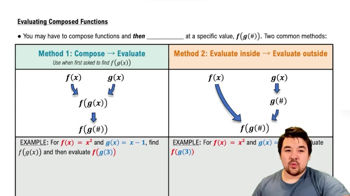
Evaluating Composed Functions

Convergence Criteria

In the context of Newton's Method, convergence criteria define when to stop the iterative process. For this problem, the iterations should continue until two successive approximations agree to five decimal places. This ensures that the approximation is accurate enough for practical purposes and helps avoid unnecessary calculations.
Recommended video:
05:44
Derivatives

Function and Derivative Evaluation

To apply Newton's Method, it is essential to evaluate both the function f(x) and its derivative f'(x) at each iteration. For the given function f(x) = sin x + x - 1, the derivative f'(x) = cos x + 1 must also be computed. Accurate evaluation of these functions is crucial for obtaining correct approximations of the root.
Recommended video:
4:26
Evaluating Composed Functions