Ch. 4 - Applications of the Derivative
Briggs - Calculus: Early Transcendentals 3rd Edition
Briggs3rd EditionCalculus: Early TranscendentalsISBN: 9780136847243Not the one you use?Change textbook
Chapter 4, Problem 4.4.17

Graphing functions Use the guidelines of this section to make a complete graph of f.
f(x) = x³ - 6x² + 9x

Verified step by step guidance
1
Step 1: Identify the domain of the function f(x) = x³ - 6x² + 9x. Since this is a polynomial function, the domain is all real numbers.
Step 2: Find the critical points by taking the derivative of f(x) to find f'(x). The derivative is f'(x) = 3x² - 12x + 9. Set f'(x) = 0 to find the critical points.
Step 3: Solve the equation 3x² - 12x + 9 = 0 to find the values of x where the function has critical points. Use the quadratic formula or factorization to find these values.
Step 4: Determine the nature of each critical point by using the second derivative test. Find f''(x) by differentiating f'(x), which gives f''(x) = 6x - 12. Evaluate f''(x) at each critical point to determine if they are local minima, maxima, or points of inflection.
Step 5: Analyze the behavior of the function as x approaches positive and negative infinity to understand the end behavior. Since the leading term is x³, the function will tend to infinity as x approaches infinity and negative infinity as x approaches negative infinity. Use this information along with the critical points to sketch the graph.

Verified video answer for a similar problem:

This video solution was recommended by our tutors as helpful for the problem above.
Video duration:
13m
Was this helpful?

Key Concepts

Here are the essential concepts you must grasp in order to answer the question correctly.

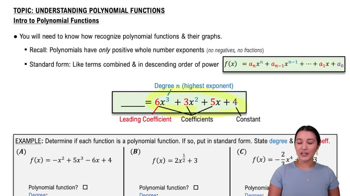
Polynomial Functions

A polynomial function is a mathematical expression involving a sum of powers in one or more variables multiplied by coefficients. In this case, f(x) = x³ - 6x² + 9x is a cubic polynomial, which means its highest degree is three. Understanding the general shape and behavior of polynomial functions is crucial for graphing them accurately.
Recommended video:
6:04
Introduction to Polynomial Functions

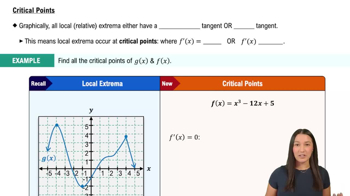
Critical Points and Extrema

Critical points occur where the derivative of a function is zero or undefined, indicating potential local maxima, minima, or points of inflection. To find these points for f(x), we need to compute its derivative, set it to zero, and solve for x. Analyzing these points helps in determining the overall shape of the graph.
Recommended video:
04:50
Critical Points

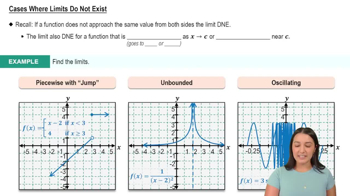
End Behavior

End behavior describes how a function behaves as the input values approach positive or negative infinity. For polynomial functions, the leading term dictates this behavior. In the case of f(x), since the leading term is x³, the graph will rise to positive infinity as x approaches positive infinity and fall to negative infinity as x approaches negative infinity, shaping the overall graph.
Recommended video:
03:07
Cases Where Limits Do Not Exist