Ch. 4 - Applications of the Derivative
Briggs - Calculus: Early Transcendentals 3rd Edition
Briggs3rd EditionCalculus: Early TranscendentalsISBN: 9780136847243Not the one you use?Change textbook
Chapter 4, Problem 4.9.85

Solving initial value problems Find the solution of the following initial value problems.


y'(Θ) = ((√2 cos³ Θ + 1)/cos² Θ); y (π/4) = 3, -π/2 < Θ < π/2

Verified step by step guidance
1
Step 1: Recognize that this is an initial value problem involving a first-order differential equation. The goal is to find the function y(Θ) that satisfies both the differential equation y'(Θ) = ((√2 cos³ Θ + 1)/cos² Θ) and the initial condition y(π/4) = 3.
Step 2: Begin by integrating the given derivative y'(Θ) to find y(Θ). Rewrite the differential equation as y'(Θ) = (√2 cos³ Θ / cos² Θ) + (1 / cos² Θ). Simplify the terms: y'(Θ) = √2 cos Θ + sec² Θ.
Step 3: Break the integral into two parts: ∫(√2 cos Θ) dΘ + ∫(sec² Θ) dΘ. Use standard integration rules. For the first term, ∫(√2 cos Θ) dΘ integrates to √2 sin Θ. For the second term, ∫(sec² Θ) dΘ integrates to tan Θ.
Step 4: Combine the results of the integration to express y(Θ): y(Θ) = √2 sin Θ + tan Θ + C, where C is the constant of integration.
Step 5: Use the initial condition y(π/4) = 3 to solve for the constant C. Substitute Θ = π/4 into the equation: y(π/4) = √2 sin(π/4) + tan(π/4) + C. Simplify using trigonometric values (sin(π/4) = √2/2 and tan(π/4) = 1) to find C. Once C is determined, substitute it back into the equation to finalize the solution for y(Θ).

Verified video answer for a similar problem:

This video solution was recommended by our tutors as helpful for the problem above.
Video duration:
3m
Was this helpful?

Key Concepts

Here are the essential concepts you must grasp in order to answer the question correctly.

Initial Value Problem (IVP)

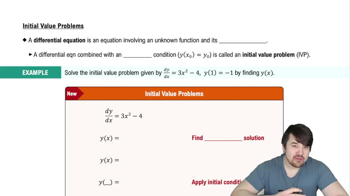
An initial value problem is a type of differential equation that specifies the value of the unknown function at a particular point. In this context, it involves finding a function y(Θ) that satisfies a given differential equation and meets a specified condition, y(π/4) = 3. Solving an IVP typically requires integrating the differential equation and applying the initial condition to determine any constants of integration.
Recommended video:
05:03
Initial Value Problems

Differential Equations

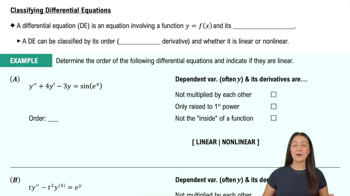
A differential equation is an equation that relates a function to its derivatives. In this case, the equation y'(Θ) = ((√2 cos³ Θ + 1)/cos² Θ) describes how the function y changes with respect to the variable Θ. Understanding how to manipulate and solve differential equations is crucial for finding the function y(Θ) that satisfies the given relationship.
Recommended video:
07:39
Classifying Differential Equations

Integration Techniques

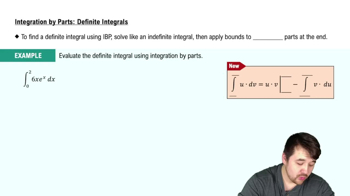
Integration techniques are methods used to find the integral of a function, which is essential for solving differential equations. In this problem, one may need to apply techniques such as substitution or integration by parts to evaluate the integral of the right-hand side of the differential equation. Mastery of these techniques allows for the determination of the function y(Θ) from its derivative.
Recommended video:
06:18
Integration by Parts for Definite Integrals