Ch. 2 - Limits and Continuity
Hass - Thomas' Calculus 15th Edition
Hass15th EditionThomas' CalculusISBN: 9780137616077Not the one you use?Change textbook
Chapter 2, Problem 2.6.68

Graphing Simple Rational Functions


Graph the rational functions in Exercises 63–68. Include the graphs and equations of the asymptotes and dominant terms.


y = 2x/(x + 1)

Verified step by step guidance
1
Identify the type of rational function: The given function is y = 2x/(x + 1), which is a rational function where the numerator and denominator are polynomials.
Determine the vertical asymptote: Set the denominator equal to zero and solve for x. The vertical asymptote occurs where the function is undefined, which is at x + 1 = 0, so x = -1.
Determine the horizontal asymptote: Compare the degrees of the numerator and denominator. Since both are linear (degree 1), the horizontal asymptote is found by dividing the leading coefficients, which gives y = 2.
Find the intercepts: For the y-intercept, set x = 0 and solve for y, which gives y = 0. For the x-intercept, set y = 0 and solve for x, which gives x = 0.
Analyze the behavior near the asymptotes: As x approaches -1 from the left and right, observe the behavior of the function to understand how it approaches the vertical asymptote. Similarly, as x approaches infinity, observe how the function approaches the horizontal asymptote y = 2.

Verified video answer for a similar problem:

This video solution was recommended by our tutors as helpful for the problem above.
Video duration:
10m
Was this helpful?

Key Concepts

Here are the essential concepts you must grasp in order to answer the question correctly.

Rational Functions

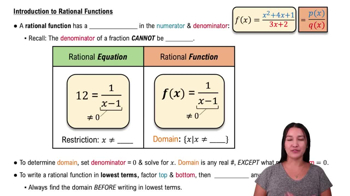
A rational function is a ratio of two polynomials, typically expressed as f(x) = P(x)/Q(x), where P(x) and Q(x) are polynomials. Understanding the behavior of rational functions involves analyzing their domain, asymptotes, and intercepts. The function y = 2x/(x + 1) is a simple rational function where the numerator and denominator are linear polynomials.
Recommended video:
6:04
Intro to Rational Functions

Asymptotes

Asymptotes are lines that a graph approaches but never touches. For rational functions, vertical asymptotes occur where the denominator is zero, and horizontal asymptotes are determined by the degrees of the polynomials. In y = 2x/(x + 1), the vertical asymptote is x = -1, and the horizontal asymptote is y = 2, as the degrees of the numerator and denominator are equal.
Recommended video:
5:37
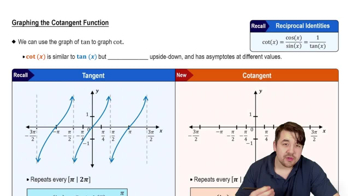
Introduction to Cotangent Graph

Dominant Terms

Dominant terms in a rational function are those that determine the end behavior of the graph. For y = 2x/(x + 1), the dominant term is 2x/x, which simplifies to 2, indicating the horizontal asymptote. Analyzing dominant terms helps predict how the function behaves as x approaches infinity or negative infinity, crucial for sketching the graph accurately.
Recommended video:
2:02
Simplifying Trig Expressions Example 1