
Ch. 9 - Differential Equations
Briggs - Calculus: Early Transcendentals 3rd Edition
Briggs3rd EditionCalculus: Early TranscendentalsISBN: 9780136847243Not the one you use?Change textbook
Chapter 9, Problem 9.2.44c

Direction field analysis Consider the first-order initial value problem y'(t)=ay+b,y(0)=A for t≥0 where a, b, and A are real numbers.
c. Draw a representative direction field in the case that a<0. Show that if A>−b/a, then the solution decreases for t≥0, and that if A<−b/a, then the solution increases for t≥0.

Verified step by step guidance
1
Recall the given differential equation: \(y'(t) = a y + b\), with initial condition \(y(0) = A\), where \(a, b, A \in \mathbb{R}\) and \(a < 0\).
Identify the equilibrium solution by setting \(y'(t) = 0\), which gives \(a y + b = 0\). Solve for \(y\) to find the equilibrium point: \(y = -\frac{b}{a}\).
Analyze the behavior of the solution relative to the equilibrium \(y = -\frac{b}{a}\). For \(y > -\frac{b}{a}\), substitute a value greater than the equilibrium into \(y'(t) = a y + b\) and use the fact that \(a < 0\) to determine the sign of \(y'(t)\), which indicates whether the solution is increasing or decreasing.
Similarly, for \(y < -\frac{b}{a}\), substitute a value less than the equilibrium into \(y'(t)\) and analyze the sign of the derivative to determine if the solution is increasing or decreasing.
Use this information to sketch a representative direction field: draw small line segments with slopes given by \(y'(t) = a y + b\) at various points \((t, y)\), showing that solutions above the equilibrium decrease toward it, and solutions below increase toward it, confirming the stability of the equilibrium and the behavior of solutions depending on whether \(A > -\frac{b}{a}\) or \(A < -\frac{b}{a}\).

Verified video answer for a similar problem:

This video solution was recommended by our tutors as helpful for the problem above.
Video duration:
3m
Was this helpful?

Key Concepts

Here are the essential concepts you must grasp in order to answer the question correctly.

Direction Fields (Slope Fields)

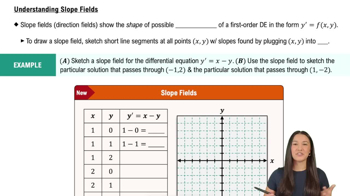
A direction field is a graphical tool that represents the slopes of solutions to a differential equation at various points. For y' = ay + b, each point (t, y) has a slope given by ay + b. Plotting small line segments with these slopes helps visualize the behavior of solutions without solving the equation explicitly.
Recommended video:
05:45
Understanding Slope Fields

Equilibrium Solutions and Stability

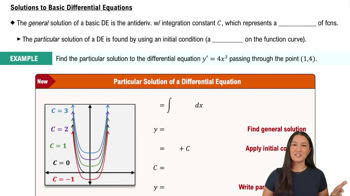
An equilibrium solution occurs where the derivative y' = 0, here at y = -b/a. This constant solution divides the behavior of other solutions. When a < 0, the equilibrium is stable, meaning solutions near it tend to move towards it over time, influencing whether solutions increase or decrease based on their initial value relative to -b/a.
Recommended video:
04:00
Solutions to Basic Differential Equations

Initial Value Problems and Solution Behavior

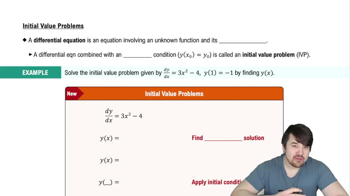
An initial value problem specifies a starting point y(0) = A. The sign of a and the position of A relative to the equilibrium -b/a determine the solution's trend. For a < 0, if A > -b/a, the solution decreases toward the equilibrium; if A < -b/a, it increases toward it, reflecting the system's dynamics over t ≥ 0.
Recommended video:
05:03
Initial Value Problems
Related Practice
Textbook Question

{Use of Tech} Logistic equation for an epidemic When an infected person is introduced into a closed and otherwise healthy community, the number of people who contract the disease (in the absence of any intervention) may be modeled by the logistic equation

 dP/dt=kP(1−P/A),P0=P_0, 

where K is a positive infection rate, A is the number of people in the community, and P0 is the number of infected people at t=0. The model also assumes no recovery. 


c. For a fixed value of K and A, describe the long-term behavior of the solutions, for any P0 with 0<P0<A. 

53
views
Textbook Question

46–48. Analyzing models The following models were discussed in Section 9.1 and reappear in later sections of this chapter. In each case, carry out the indicated analysis using direction fields.


Drug infusion The delivery of a drug (such as an antibiotic) through an intravenous line may be modeled by the differential equation m′(t)+km(t)=I, where m(t) is the mass of the drug in the blood at time t≥0, K is a constant that describes the rate at which the drug is absorbed, and I is the infusion rate. Let I=10mg/hr and k=0.05 hr^−1.

c. What is the equilibrium solution?

65
views
Textbook Question

{Use of Tech} Fish harvesting A fish hatchery has 500 fish at t=0, when harvesting begins at a rate of b>0fish/year The fish population is modeled by the initial value problem y′(t)=0.01y−b,y(0)=500 where t is measured in years.


c. Graph the solution in the case that b=60fish/year. Describe the solution.

36
views
Textbook Question

17–20. Increasing and decreasing solutions Consider the following differential equations. A detailed direction field is not needed.


c. Which initial conditions y(0) = A lead to solutions that are increasing in time? Decreasing?


y'(t) = cos y for |y| ≤ π

36
views
Textbook Question

[Use of Tech] Analysis of a separable equation Consider the differential equation yy'(t) = ½eᵗ + t and carry out the following analysis.

c. Graph the solutions in part (b) and describe their behavior as t increases. 

43
views
Textbook Question

{Use of Tech} Free fall An object in free fall may be modeled by assuming the only forces at work are the gravitational force and air resistance. By Newton’s Second Law of Motion (mass end . acceleration = the sum of external forces), the velocity of the object satisfies the differential equation 


m · v'(t) = mg + f(v)

mass | acceleration | external forces


where f is a function that models the air resistance (assuming the positive direction is downward). One common assumption (often used for motion in air) is that f(v)=−kv^2, for t≥0, where k>0 is a drag coefficient.


c. Find the solution of this separable equation assuming v(0)=0 and 0<v²<g/a. 

61
views