Ch.12 - Parametric and Polar Curves
Briggs - Calculus: Early Transcendentals 3rd Edition
Briggs3rd EditionCalculus: Early TranscendentalsISBN: 9780136847243Not the one you use?Change textbook
Chapter 12, Problem 12.R.34b

Jake’s response Jake responds to Liz (Exercise 33) with a graph that shows his love for her is infinite. Sketch each of the following curves. Which one should Jake send to Liz to get an infinity symbol?
b. r=(½)+sinθ

Verified step by step guidance
1
Understand that the problem involves sketching the curve given in polar coordinates: \(r = \frac{1}{2} + \sin \theta\).
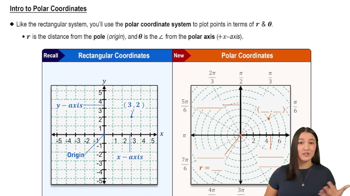
Recall that in polar coordinates, \(r\) represents the distance from the origin to a point, and \(\theta\) is the angle measured from the positive x-axis.
To sketch the curve, create a table of values by choosing several values of \(\theta\) (for example, \(0\), \(\frac{\pi}{2}\), \(\pi\), \(\frac{3\pi}{2}\), and \(2\pi\)) and compute the corresponding \(r\) values using the formula \(r = \frac{1}{2} + \sin \theta\).
Plot the points in polar coordinates by marking the distance \(r\) from the origin at each angle \(\theta\), then connect these points smoothly to visualize the curve.
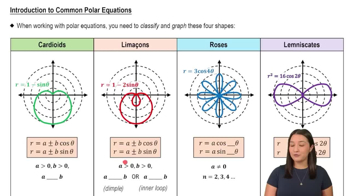
Analyze the shape of the curve to determine if it resembles an infinity symbol (a figure-eight or lemniscate). Since \(r = \frac{1}{2} + \sin \theta\) is a type of limacon, it will not form an infinity symbol. Therefore, Jake should choose a different curve that produces a lemniscate shape to represent the infinity symbol.

Verified video answer for a similar problem:

This video solution was recommended by our tutors as helpful for the problem above.
Video duration:
2m
Was this helpful?

Key Concepts

Here are the essential concepts you must grasp in order to answer the question correctly.

Polar Coordinates and Graphing

Polar coordinates represent points using a radius and an angle (r, θ), where r is the distance from the origin and θ is the angle from the positive x-axis. Understanding how to plot r as a function of θ is essential for sketching curves like r = (1/2) + sinθ, which produces shapes based on trigonometric variations.
Recommended video:
05:32
Intro to Polar Coordinates

Trigonometric Functions in Polar Equations

Trigonometric functions such as sine and cosine influence the shape and symmetry of polar graphs. For r = (1/2) + sinθ, the sine function causes the radius to oscillate, creating a closed, petal-like curve rather than an infinite one, which is important for interpreting the graph's behavior.
Recommended video:
6:04
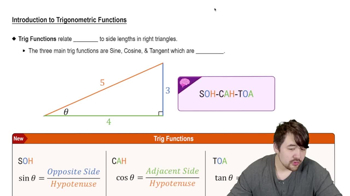
Introduction to Trigonometric Functions

Infinity Symbol in Polar Graphs

The infinity symbol (∞) in polar graphs typically appears as a figure-eight or lemniscate shape, often generated by equations like r² = a² cos 2θ. Recognizing which polar equations produce this shape helps determine which curve Jake should send to represent infinite love.
Recommended video:
3:47
Introduction to Common Polar Equations