Ch. 10 - Sequences and Infinite Series
Briggs - Calculus: Early Transcendentals 3rd Edition
Briggs3rd EditionCalculus: Early TranscendentalsISBN: 9780136847243Not the one you use?Change textbook
Chapter 10, Problem 10.5.35

9–36. Comparison tests Use the Comparison Test or the Limit Comparison Test to determine whether the following series converge.
{Use of Tech} ∑ (k = 1 to ∞) 1 / (4lnk)

Verified step by step guidance
1
Identify the given series: \( \sum_{k=1}^{\infty} \frac{1}{4 \ln k} \). Note that the term for \(k=1\) is undefined since \(\ln 1 = 0\), so consider the series starting from \(k=2\) instead.
Recall that the Comparison Test and Limit Comparison Test are used to determine convergence by comparing the given series to a known benchmark series. Since the terms involve \( \frac{1}{\ln k} \), consider comparing it to the harmonic series \( \sum \frac{1}{k} \), which is divergent.
Set up the Limit Comparison Test by defining \(a_k = \frac{1}{4 \ln k} \) and \(b_k = \frac{1}{k} \). Compute the limit \( L = \lim_{k \to \infty} \frac{a_k}{b_k} = \lim_{k \to \infty} \frac{1/(4 \ln k)}{1/k} = \lim_{k \to \infty} \frac{k}{4 \ln k} \).
Analyze the limit \( L = \lim_{k \to \infty} \frac{k}{4 \ln k} \). Since \(k\) grows faster than \(\ln k\), this limit tends to infinity, which means the Limit Comparison Test with \(b_k = \frac{1}{k}\) is inconclusive.
Try a different comparison series, such as \(b_k = \frac{1}{k^p} \) for some \(p > 0\), or consider the integral test for \( \int \frac{1}{\ln x} dx \) to analyze convergence. The integral test can help determine if the series converges or diverges by examining the behavior of the integral of the function \(f(x) = \frac{1}{4 \ln x} \) for \(x \geq 2\).

Verified video answer for a similar problem:

This video solution was recommended by our tutors as helpful for the problem above.
Video duration:
3m

Key Concepts

Here are the essential concepts you must grasp in order to answer the question correctly.

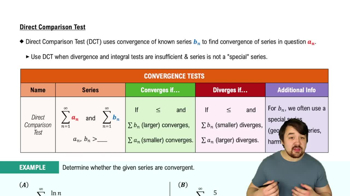
Comparison Test

The Comparison Test determines the convergence or divergence of a series by comparing it to a second series with known behavior. If the terms of the given series are smaller than those of a convergent series, it also converges; if larger than those of a divergent series, it diverges.
Recommended video:
Guided course
09:25
Direct Comparison Test

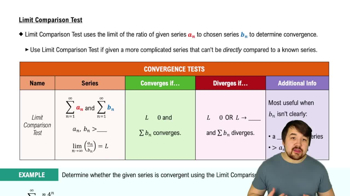
Limit Comparison Test

The Limit Comparison Test compares two series by taking the limit of the ratio of their terms. If this limit is a positive finite number, both series either converge or diverge together, making it useful when direct comparison is difficult.
Recommended video:
Guided course
07:45
Limit Comparison Test

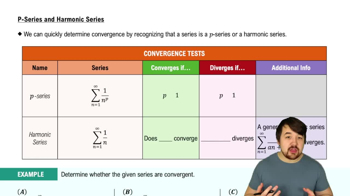
Behavior of the Harmonic Series and Logarithmic Terms

Understanding the divergence of the harmonic series and how logarithmic terms affect convergence is crucial. Since ∑ 1/k diverges, series like ∑ 1/(ln k) require careful comparison, as logarithmic growth is slow and affects the series' convergence properties.
Recommended video:
Guided course
04:30
P-Series and Harmonic Series
Related Practice
Textbook Question

13–20. Explicit formulas Write the first four terms of the sequence { aₙ }∞ₙ₌₁. 

aₙ = 1/10ⁿ

76
views

Textbook Question

32–49. Choose your test Use the test of your choice to determine whether the following series converge absolutely, converge conditionally, or diverge.

∑ (from k = 1 to ∞) k¹⁰⁰ / (k + 1)!

47
views
Textbook Question

9–36. Comparison tests Use the Comparison Test or the Limit Comparison Test to determine whether the following series converge.


∑ (k = 1 to ∞) (2 + (−1)ᵏ) / k²

36
views
Textbook Question

16–17. {Use of Tech} Periodic savings

Suppose you deposit m dollars at the beginning of every month in a savings account that earns a monthly interest rate of r, which is the annual interest rate divided by 12 (for example, if the annual interest rate is 2.4%, r = 0.024/12 = 0.002). For an initial investment of m dollars, the amount of money in your account at the beginning of the second month is the sum of your second deposit and your initial deposit plus interest, or m + m(1 + r). Continuing in this fashion, it can be shown that the amount of money in your account after n months is


Aₙ = m + m(1 + r) + ⋯ + m(1 + r)ⁿ⁻¹.


Use geometric sums to determine the amount of money in your savings account after 5 years (60 months) using the given monthly deposit and interest rate.


17. Monthly deposits of \$250 at a monthly interest rate of 0.2%

67
views
Textbook Question

39–44. {Use of Tech} Estimating infinite series Estimate the value of the following convergent series with an absolute error less than 10⁻³.


∑ (k = 1 to ∞) (−1)ᵏ / k⁵

39
views
Textbook Question

17–22. Integral Test Use the Integral Test to determine whether the following series converge after showing that the conditions of the Integral Test are satisfied.

∑ (k = 1 to ∞) 1 / (∛(5k + 3))

85
views