Ch. 3 - Derivatives
Briggs - Calculus: Early Transcendentals 3rd Edition
Briggs3rd EditionCalculus: Early TranscendentalsISBN: 9780136847243Not the one you use?Change textbook
Chapter 3, Problem 3.8.93

90–93. {Use of Tech} Work carefully Proceed with caution when using implicit differentiation to find points at which a curve has a specified slope. For the following curves, find the points on the curve (if they exist) at which the tangent line is horizontal or vertical. Once you have found possible points, make sure that they actually lie on the curve. Confirm your results with a graph.
x(1−y²)+y³=0

Verified step by step guidance
1
Start by understanding the problem: We need to find points on the curve where the tangent line is horizontal or vertical. The curve is given by the equation \( x(1-y^2) + y^3 = 0 \).
To find where the tangent line is horizontal, we need to find where the derivative \( \frac{dy}{dx} = 0 \). Use implicit differentiation on the given equation. Differentiate both sides with respect to \( x \).
Apply the product rule to \( x(1-y^2) \) and the chain rule to \( y^3 \). This gives: \( (1-y^2) + x(-2y \frac{dy}{dx}) + 3y^2 \frac{dy}{dx} = 0 \).
Rearrange the differentiated equation to solve for \( \frac{dy}{dx} \): \( \frac{dy}{dx} = \frac{y^2 - 1}{3y^2 - 2xy} \). Set \( \frac{dy}{dx} = 0 \) to find horizontal tangents, which implies \( y^2 - 1 = 0 \). Solve for \( y \).
For vertical tangents, set the denominator of \( \frac{dy}{dx} \) to zero: \( 3y^2 - 2xy = 0 \). Solve for \( x \) in terms of \( y \) or vice versa. Check if these points satisfy the original curve equation.

Verified video answer for a similar problem:

This video solution was recommended by our tutors as helpful for the problem above.
Video duration:
6m
Was this helpful?

Key Concepts

Here are the essential concepts you must grasp in order to answer the question correctly.

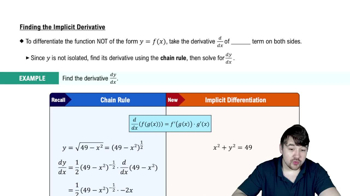
Implicit Differentiation

Implicit differentiation is a technique used to differentiate equations where the dependent and independent variables are not explicitly separated. Instead of solving for one variable in terms of the other, we differentiate both sides of the equation with respect to the independent variable, applying the chain rule as necessary. This method is particularly useful for finding derivatives of curves defined by equations that cannot be easily rearranged.
Recommended video:
05:14
Finding The Implicit Derivative

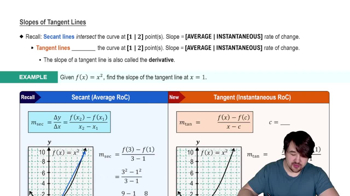
Tangent Lines and Slopes

The slope of a tangent line to a curve at a given point represents the instantaneous rate of change of the function at that point. A horizontal tangent line indicates a slope of zero, while a vertical tangent line is associated with an undefined slope. Identifying points where the tangent line is horizontal or vertical involves setting the derivative equal to zero or undefined, respectively, and solving for the corresponding coordinates on the curve.
Recommended video:
05:13
Slopes of Tangent Lines

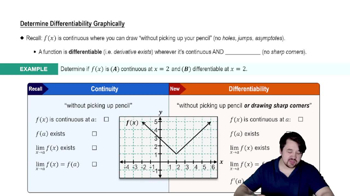
Graphical Confirmation

Graphical confirmation involves plotting the curve and visually inspecting the points of interest to verify the results obtained through calculus. By graphing the function, one can observe the behavior of the curve, including the locations of horizontal and vertical tangents. This step is crucial for ensuring that the calculated points indeed lie on the curve and for gaining a deeper understanding of the function's characteristics.
Recommended video:
05:02
Determining Differentiability Graphically