
Ch. 8 - Integration Techniques
Briggs - Calculus: Early Transcendentals 3rd Edition
Briggs3rd EditionCalculus: Early TranscendentalsISBN: 9780136847243Not the one you use?Change textbook
Chapter 8, Problem 8.9.106

102–106. Laplace transforms A powerful tool in solving problems in engineering and physics is the Laplace transform. Given a function f(t), the Laplace transform is a new function F(s) defined by F(s) = ∫[0 to ∞] e^(-st) f(t) dt, where we assume s is a positive real number. For example, to find the Laplace transform of f(t) = e^(-t), the following improper integral is evaluated using integration by parts:
F(s) = ∫[0 to ∞] e^(-st) e^(-t) dt = ∫[0 to ∞] e^(-(s+1)t) dt = 1/(s+1).
Verify the following Laplace transforms, where a is a real number.
106. f(t) = cos(at) → F(s) = s/(s² + a²)

Verified step by step guidance
1
Start with the definition of the Laplace transform for the function \(f(t) = \cos(at)\): \[F(s) = \int_0^{\infty} e^{-st} \cos(at) \, dt\]
Recall that the integral of the product of an exponential and a cosine function can be evaluated using the formula: \[\int_0^{\infty} e^{-pt} \cos(qt) \, dt = \frac{p}{p^2 + q^2}\] where \(p > 0\) and \(q\) are real numbers.
In this problem, identify \(p = s\) and \(q = a\), since the integral matches the form with \(e^{-st}\) and \(\cos(at)\).
Apply the formula directly to get: \[F(s) = \frac{s}{s^2 + a^2}\] which is the Laplace transform of \(\cos(at)\).
To fully verify, you could also perform the integral by expressing \(\cos(at)\) as the real part of \(e^{iat}\) and then integrating \(e^{-(s - ia)t}\), ensuring the integral converges for \(s > 0\).

Verified video answer for a similar problem:

This video solution was recommended by our tutors as helpful for the problem above.
Video duration:
5m
Was this helpful?

Key Concepts

Here are the essential concepts you must grasp in order to answer the question correctly.

Definition of the Laplace Transform

The Laplace transform converts a time-domain function f(t) into a complex frequency-domain function F(s) using the integral F(s) = ∫₀^∞ e^(-st) f(t) dt. This transformation simplifies solving differential equations by turning them into algebraic equations, where s is a complex variable with a positive real part to ensure convergence.
Recommended video:
5:25
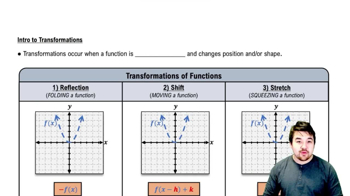
Intro to Transformations

Improper Integrals and Convergence

Evaluating the Laplace transform involves improper integrals extending to infinity. Understanding when these integrals converge is crucial, typically requiring the exponential term e^(-st) to dominate f(t) as t → ∞. This ensures the integral has a finite value, allowing the transform to exist and be computed.
Recommended video:
11:11
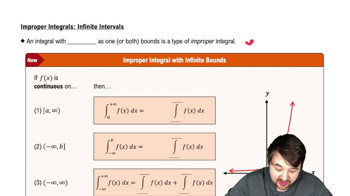
Improper Integrals: Infinite Intervals

Laplace Transform of Trigonometric Functions

The Laplace transform of functions like cos(at) is derived using integration techniques or known formulas, resulting in F(s) = s / (s² + a²). This formula is essential for solving differential equations involving oscillatory behavior, linking time-domain cosine functions to rational expressions in s.
Recommended video:
5:25
Intro to Transformations