
Ch. 9 - Differential Equations
Briggs - Calculus: Early Transcendentals 3rd Edition
Briggs3rd EditionCalculus: Early TranscendentalsISBN: 9780136847243Not the one you use?Change textbook
Chapter 9, Problem 9.2.34c

33–36. {Use of Tech} Computing Euler approximations Use a calculator or computer program to carry out the following steps.
c. Repeating parts (a) and (b) using half the time step used in those calculations, again find an approximation to y(T).


y′(t) = 6 - 2y, y(0) = -1; Δt = 0.2, T = 3; y(t) = 3 - 4e⁻²ᵗ

Verified step by step guidance
1
Identify the differential equation and initial condition: \(y'(t) = 6 - 2y\), with \(y(0) = -1\).
Note the given time step \(\Delta t = 0.2\) and the target time \(T = 3\). The problem asks to repeat the Euler approximation using half the time step, so calculate the new time step as \(\Delta t = 0.1\).
Determine the number of steps needed to reach \(T=3\) using the new time step: \(n = \frac{T}{\Delta t} = \frac{3}{0.1} = 30\) steps.
Set up the Euler iteration formula: \(y_{k+1} = y_k + \Delta t \cdot f(t_k, y_k)\), where \(f(t, y) = 6 - 2y\). Start with \(y_0 = -1\) at \(t_0 = 0\).
Perform the iteration 30 times, updating \(y\) at each step using the formula, to approximate \(y(3)\) with the smaller time step.

Verified video answer for a similar problem:

This video solution was recommended by our tutors as helpful for the problem above.
Video duration:
4m
Was this helpful?

Key Concepts

Here are the essential concepts you must grasp in order to answer the question correctly.

Euler's Method for Numerical Approximation

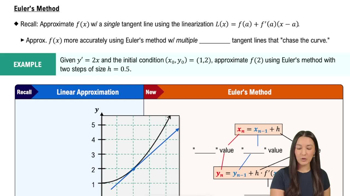
Euler's method is a numerical technique to approximate solutions of first-order differential equations. It uses a stepwise approach, updating the solution by moving along the slope given by the differential equation at each step. The formula is y_{n+1} = y_n + Δt * f(t_n, y_n), where Δt is the time step.
Recommended video:
07:33
Euler's Method

Effect of Step Size on Accuracy

The step size Δt in Euler's method controls the increments at which the solution is approximated. Smaller step sizes generally yield more accurate results because they better capture the curve's behavior, but require more computations. Halving Δt typically improves the approximation by reducing local truncation error.
Recommended video:
07:33
Euler's Method

Analytical Solution of Differential Equations

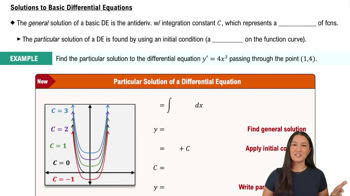
An analytical solution is an exact formula that satisfies the differential equation and initial conditions. For y' = 6 - 2y with y(0) = -1, the solution y(t) = 3 - 4e^{-2t} provides a benchmark to compare numerical approximations and assess their accuracy.
Recommended video:
04:00
Solutions to Basic Differential Equations
Related Practice
Textbook Question

{Use of Tech} Logistic equation for an epidemic When an infected person is introduced into a closed and otherwise healthy community, the number of people who contract the disease (in the absence of any intervention) may be modeled by the logistic equation

 dP/dt=kP(1−P/A),P0=P_0, 

where K is a positive infection rate, A is the number of people in the community, and P0 is the number of infected people at t=0. The model also assumes no recovery. 


c. For a fixed value of K and A, describe the long-term behavior of the solutions, for any P0 with 0<P0<A. 

53
views
Textbook Question

46–48. Analyzing models The following models were discussed in Section 9.1 and reappear in later sections of this chapter. In each case, carry out the indicated analysis using direction fields.


Drug infusion The delivery of a drug (such as an antibiotic) through an intravenous line may be modeled by the differential equation m′(t)+km(t)=I, where m(t) is the mass of the drug in the blood at time t≥0, K is a constant that describes the rate at which the drug is absorbed, and I is the infusion rate. Let I=10mg/hr and k=0.05 hr^−1.

c. What is the equilibrium solution?

66
views
Textbook Question

27–30. Predator-prey models Consider the following pairs of differential equations that model a predator-prey system with populations x and y. In each case, carry out the following steps.


c. Find the equilibrium points for the system.


x′(t) = −3x + 6xy, y′(t) = y − 4xy

52
views
Textbook Question

17–20. Increasing and decreasing solutions Consider the following differential equations. A detailed direction field is not needed.


c. Which initial conditions y(0) = A lead to solutions that are increasing in time? Decreasing?


y'(t) = cos y for |y| ≤ π

37
views
Textbook Question

Explain why or why not Determine whether the following statements are true and give an explanation or counterexample.

c. The general solution of the equation yy'(x) = xe⁻ʸ can be found using integration by parts.

58
views
Textbook Question

52-56. In this section, several models are presented and the solution of the associated differential equation is given. Later in the chapter, we present methods for solving these differential equations.


{Use of Tech} Free fall One possible model that describes the free fall of an object in a gravitational field subject to air resistance uses the equation v'(t) = g - bv, where v(t) is the velocity of the object for t ≥ 0, g = 9.8 m/s² is the acceleration due to gravity, and b > 0 is a constant that involves the mass of the object and the air resistance.


c. Using the graph in part (b), estimate the terminal velocity lim(t→∞) v(t).

43
views