
Ch. 9 - Differential Equations
Briggs - Calculus: Early Transcendentals 3rd Edition
Briggs3rd EditionCalculus: Early TranscendentalsISBN: 9780136847243Not the one you use?Change textbook
Chapter 9, Problem 9.3.42a

42–43. Implicit solutions for separable equations For the following separable equations, carry out the indicated analysis.
a. Find the general solution of the equation.


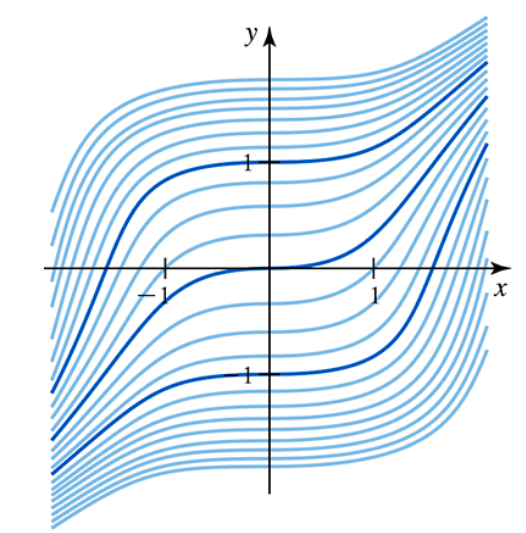
y'(t) = t²/(y² + 1); y(−1) = 1, y(0) = 0, y(−1) = −1


Verified step by step guidance
1
Identify that the given differential equation is separable: \(y'(t) = \frac{t^2}{y^2 + 1}\).
Rewrite the equation in separable form by expressing \(y'\) as \(\frac{dy}{dt}\) and rearranging terms to isolate \(y\) and \(t\): \( (y^2 + 1) dy = t^2 dt\).
Integrate both sides separately: \(\int (y^2 + 1) dy = \int t^2 dt\).
Compute the integrals: The left side becomes \(\int y^2 dy + \int 1 dy = \frac{y^3}{3} + y\), and the right side becomes \(\frac{t^3}{3} + C\), where \(C\) is the constant of integration.
Write the implicit general solution as \(\frac{y^3}{3} + y = \frac{t^3}{3} + C\). Use the initial conditions \(y(-1) = 1\), \(y(0) = 0\), and \(y(-1) = -1\) to solve for the constant \(C\) for each case.

Verified video answer for a similar problem:

This video solution was recommended by our tutors as helpful for the problem above.
Video duration:
1m
Was this helpful?

Key Concepts

Here are the essential concepts you must grasp in order to answer the question correctly.

Separable Differential Equations

A separable differential equation can be written as the product of a function of t and a function of y, allowing the variables to be separated on opposite sides of the equation. This enables integration with respect to each variable independently to find the general solution.
Recommended video:
06:06
Solving Separable Differential Equations

Implicit Solutions

An implicit solution is a relation involving both variables that satisfies the differential equation but is not explicitly solved for y. Often, after integrating, the solution is given implicitly, requiring further manipulation or interpretation to understand the behavior of y.
Recommended video:
05:14
Finding The Implicit Derivative

Initial Conditions and Solution Curves

Initial conditions specify particular values of y at given t, allowing determination of the constant of integration and thus a unique solution curve. The direction field or slope field graphically represents these solutions, showing how different initial values lead to different solution trajectories.
Recommended video:
05:03
Initial Value Problems
Related Practice
Textbook Question

38–43. Equilibrium solutions A differential equation of the form y′(t)=f(y) is said to be autonomous (the function f depends only on y). The constant function y=y0 is an equilibrium solution of the equation provided f(y0)=0 (because then y'(t)=0 and the solution remains constant for all t). Note that equilibrium solutions correspond to horizontal lines in the direction field. Note also that for autonomous equations, the direction field is independent of t. Carry out the following analysis on the given equations.

a. Find the equilibrium solutions. 


y′(t) = y(y - 3)

51
views
Textbook Question

U.S. population projections According to the U.S. Census Bureau, the nation’s population (to the nearest million) was 296 million in 2005 and 321 million in 2015. The Bureau also projects a 2050 population of 398 million. To construct a logistic model, both the growth rate and the carrying capacity must be estimated. There are several ways to estimate these parameters. Here is one approach:


a. Assume t = 0 corresponds to 2005 and that the population growth is exponential for the first ten years; that is, between 2005 and 2015, the population is given by P(t) = P(0)exp(rt). Estimate the growth rate r using this assumption.

134
views
Textbook Question

A second-order equation Consider the differential equation y''(t) - k²y(t) = 0 where k > 0 is a real number.


a. Verify by substitution that when k = 1, a solution of the equation is y(t) = C₁eᵗ + C₂e⁻ᵗ. You may assume this function is the general solution.

86
views
Textbook Question

Cooling time Suppose an object with an initial temperature of T₀ > 0 is put in surroundings with an ambient temperature of A, where A < T₀/2. Let t₁/₂ be the time required for the object to cool to T₀/2.


a. Show that t₁/₂ = −1/k ln((T₀ − 2A)/(2(T₀ − A))).

70
views
Textbook Question

{Use of Tech} Endowment model An endowment is an investment account in which the balance ideally remains constant and withdrawals are made on the interest earned by the account. Such an account may be modeled by the initial value problem B′(t)=rB−m, for t≥0, with B(0)=B0. The constant r>0 reflects the annual interest rate, m>0 is the annual rate of withdrawal, B0 is the initial balance in the account, and t is measured in years.


a. Solve the initial value problem with r=0.05, m=\$1000/year, and B0=\$15,000 Does the balance in the account increase or decrease?

32
views
Textbook Question

23–26. Stirred tank reactions For each of the following stirred tank reactions, carry out the following analysis.

a. Write an initial value problem for the mass of the substance.


A 500-L tank is initially filled with pure water. A copper sulfate solution with a concentration of 20 g/L flows into the tank at a rate of 4 L/min. The thoroughly mixed solution is drained from the tank at a rate of 4 L/min.

44
views