Cartesian lemniscate Find the equation in Cartesian coordinates of the lemniscate r² = a² cos 2θ, where a is a real number.
Ch.12 - Parametric and Polar Curves
Briggs3rd EditionCalculus: Early TranscendentalsISBN: 9780136847243Not the one you use?Change textbook
Chapter 12, Problem 12.4.22
13–30. Graphing conic sections Determine whether the following equations describe a parabola, an ellipse, or a hyperbola, and then sketch a graph of the curve. For each parabola, specify the location of the focus and the equation of the directrix; for each ellipse, label the coordinates of the vertices and foci, and find the lengths of the major and minor axes; for each hyperbola, label the coordinates of the vertices and foci, and find the equations of the asymptotes.
25y² - 4x² = 100
Verified step by step guidance1
Rewrite the given equation \(25y^{2} - 4x^{2} = 100\) in standard form by dividing both sides by 100 to isolate the terms: \(\frac{25y^{2}}{100} - \frac{4x^{2}}{100} = 1\).
Simplify the fractions to get \(\frac{y^{2}}{4} - \frac{x^{2}}{25} = 1\). This is the standard form of a hyperbola centered at the origin with the \(y^{2}\) term positive, indicating it opens vertically.
Identify the values of \(a^{2}\) and \(b^{2}\) from the equation: \(a^{2} = 4\) and \(b^{2} = 25\). Here, \(a\) corresponds to the distance from the center to each vertex along the \(y\)-axis, and \(b\) relates to the shape of the hyperbola.
Find the vertices of the hyperbola, which lie along the \(y\)-axis at \((0, \pm a)\), so the vertices are at \((0, \pm 2)\).
Calculate the focal distance \(c\) using the relationship \(c^{2} = a^{2} + b^{2}\), then find the coordinates of the foci at \((0, \pm c)\). Finally, write the equations of the asymptotes, which for a vertical hyperbola centered at the origin are \(y = \pm \frac{a}{b} x\).

Verified video answer for a similar problem:
This video solution was recommended by our tutors as helpful for the problem above.
Video duration:
5mWas this helpful?
Key Concepts
Here are the essential concepts you must grasp in order to answer the question correctly.
Identification of Conic Sections from General Equations
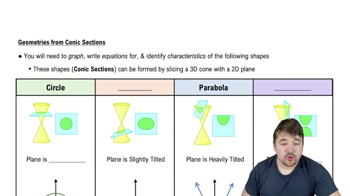
Conic sections are curves obtained by intersecting a plane with a double-napped cone. The general second-degree equation Ax² + By² + Cx + Dy + E = 0 can represent a parabola, ellipse, or hyperbola depending on the signs and values of A and B. If A and B have opposite signs, the conic is a hyperbola; if they are equal and nonzero, it is a circle; if both are positive but unequal, it is an ellipse; if one variable is squared and the other is linear, it is a parabola.
Recommended video:
Geometries from Conic Sections
Standard Forms and Key Features of Hyperbolas
A hyperbola's standard form is (x-h)²/a² - (y-k)²/b² = 1 or (y-k)²/a² - (x-h)²/b² = 1, where (h,k) is the center. Key features include vertices (points where the hyperbola intersects its principal axis), foci (points inside the branches related to the definition of the hyperbola), and asymptotes (lines the hyperbola approaches but never touches). These features help in sketching and understanding the hyperbola's shape.
Recommended video:
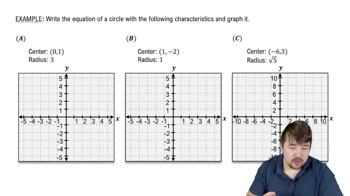
Circles in Standard Form Example 1
Graphing and Analyzing Conic Sections
Graphing conic sections involves rewriting the equation in standard form, identifying the center, vertices, foci, and axes lengths, and plotting these points. For hyperbolas, asymptotes are found using slopes ±b/a or ±a/b depending on orientation. Labeling these elements accurately provides a clear visual representation and aids in understanding the conic's geometric properties.
Recommended video:
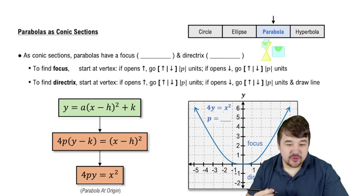
Parabolas as Conic Sections
Related Practice
Textbook Question
73
views
Textbook Question
What is the polar equation of the vertical line x = 5?
70
views
Textbook Question
37–48. Polar-to-Cartesian coordinates Convert the following equations to Cartesian coordinates. Describe the resulting curve.
r = 3 csc θ
86
views
Textbook Question
37–52. Curves to parametric equations Find parametric equations for the following curves. Include an interval for the parameter values. Answers are not unique.
The line segment starting at P(0, 0) and ending at Q(2, 8)
79
views
Textbook Question
What is the slope of the line θ=π/3?
101
views
Textbook Question
53–56. Eccentricity-directrix approach Find an equation of the following curves, assuming the center is at the origin. Sketch a graph labeling the vertices, foci, asymptotes (if they exist), and directrices. Use a graphing utility to check your work.
An ellipse with vertices (0, ±9) and eccentricity ¼
31
views