Ch. 1 - Equations and Inequalities
Lial - College Algebra 13th Edition
Lial13th EditionCollege AlgebraISBN: 9780136881063Not the one you use?Change textbook
Chapter 2, Problem 72

Solve each equation. ∜(3x+1)=1

Verified step by step guidance
1
Recognize that the equation involves a fourth root, which can be rewritten using exponents. The fourth root of an expression \(a\) is equivalent to \(a^{\frac{1}{4}}\). So rewrite the equation \(\sqrt[4]{3x+1} = 1\) as \((3x + 1)^{\frac{1}{4}} = 1\).
To eliminate the fractional exponent, raise both sides of the equation to the power of 4. This gives \(\left((3x + 1)^{\frac{1}{4}}\right)^4 = 1^4\), which simplifies to \$3x + 1 = 1$.
Now solve the resulting linear equation \$3x + 1 = 1\(. Subtract 1 from both sides to isolate the term with \)x\(: \)3x = 1 - 1$.
Simplify the right side: \$3x = 0\(. Then divide both sides by 3 to solve for \)x$: \(x = \frac{0}{3}\).
Simplify the fraction to find the value of \(x\). Finally, check your solution by substituting it back into the original equation to ensure it satisfies the equation.

Verified video answer for a similar problem:

This video solution was recommended by our tutors as helpful for the problem above.
Video duration:
1m
Was this helpful?

Key Concepts

Here are the essential concepts you must grasp in order to answer the question correctly.

Radical Expressions and Roots

A radical expression involves roots such as square roots, cube roots, or fourth roots (∜). Understanding how to interpret and manipulate these roots is essential, as the fourth root of a number is the value that, when raised to the fourth power, equals the original number.
Recommended video:
Guided course
05:45
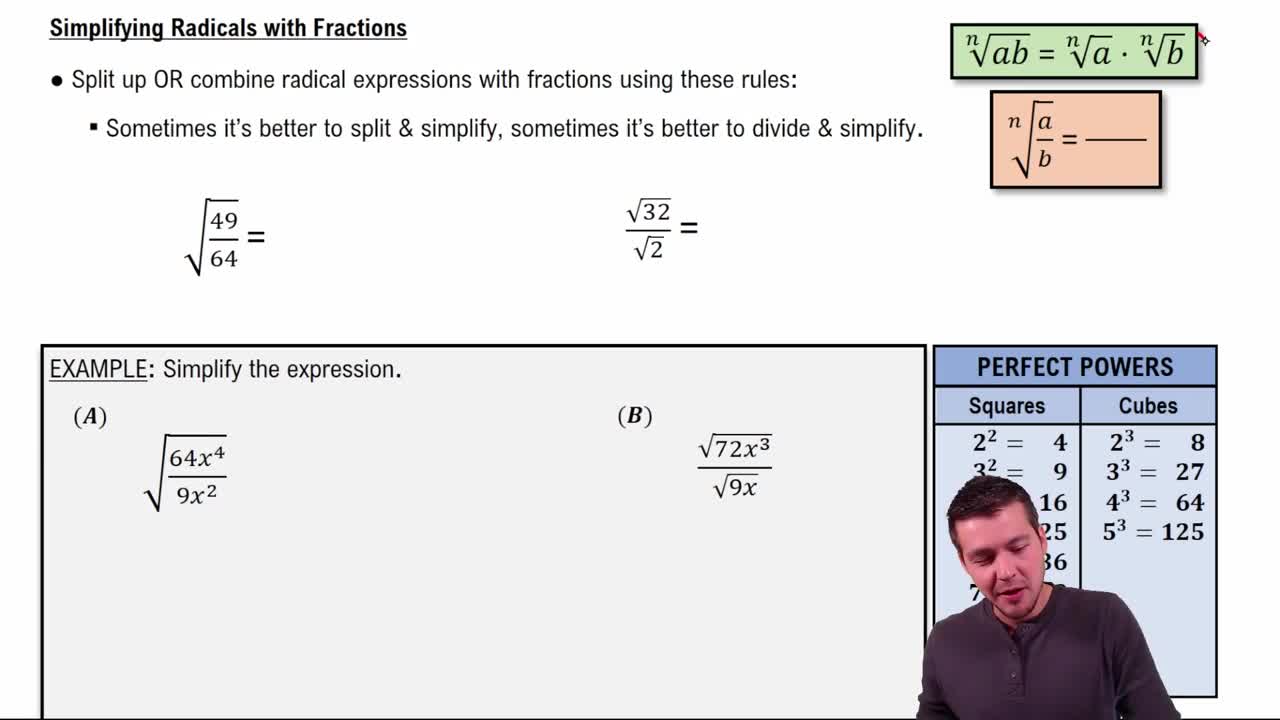
Radical Expressions with Fractions

Isolating the Variable

To solve equations involving radicals, first isolate the radical expression on one side. This allows you to eliminate the root by raising both sides of the equation to the appropriate power, simplifying the equation to a polynomial form that is easier to solve.
Recommended video:
Guided course
05:28
Equations with Two Variables

Checking for Extraneous Solutions

When both sides of an equation are raised to a power, extraneous solutions may arise. It is important to substitute solutions back into the original equation to verify their validity and discard any that do not satisfy the original radical equation.
Recommended video:
05:21
Restrictions on Rational Equations