Ch. P - Fundamental Concepts of Algebra
Blitzer - College Algebra 8th Edition
Blitzer8th EditionCollege AlgebraISBN: 9780136970514Not the one you use?Change textbook
Chapter 1, Problem 50

Rationalize the denominator. 30/√5

Verified step by step guidance
1
Identify the expression to rationalize: \(\frac{30}{\sqrt{5}}\).
Recall that rationalizing the denominator means eliminating the square root from the denominator by multiplying numerator and denominator by the same radical.
Multiply both numerator and denominator by \(\sqrt{5}\) to get \(\frac{30}{\sqrt{5}} \times \frac{\sqrt{5}}{\sqrt{5}}\).
Use the property \(\sqrt{a} \times \sqrt{a} = a\) to simplify the denominator: \(\sqrt{5} \times \sqrt{5} = 5\).
Write the new expression as \(\frac{30 \times \sqrt{5}}{5}\) and simplify the fraction if possible.

Verified video answer for a similar problem:

This video solution was recommended by our tutors as helpful for the problem above.
Video duration:
53s
Was this helpful?

Key Concepts

Here are the essential concepts you must grasp in order to answer the question correctly.

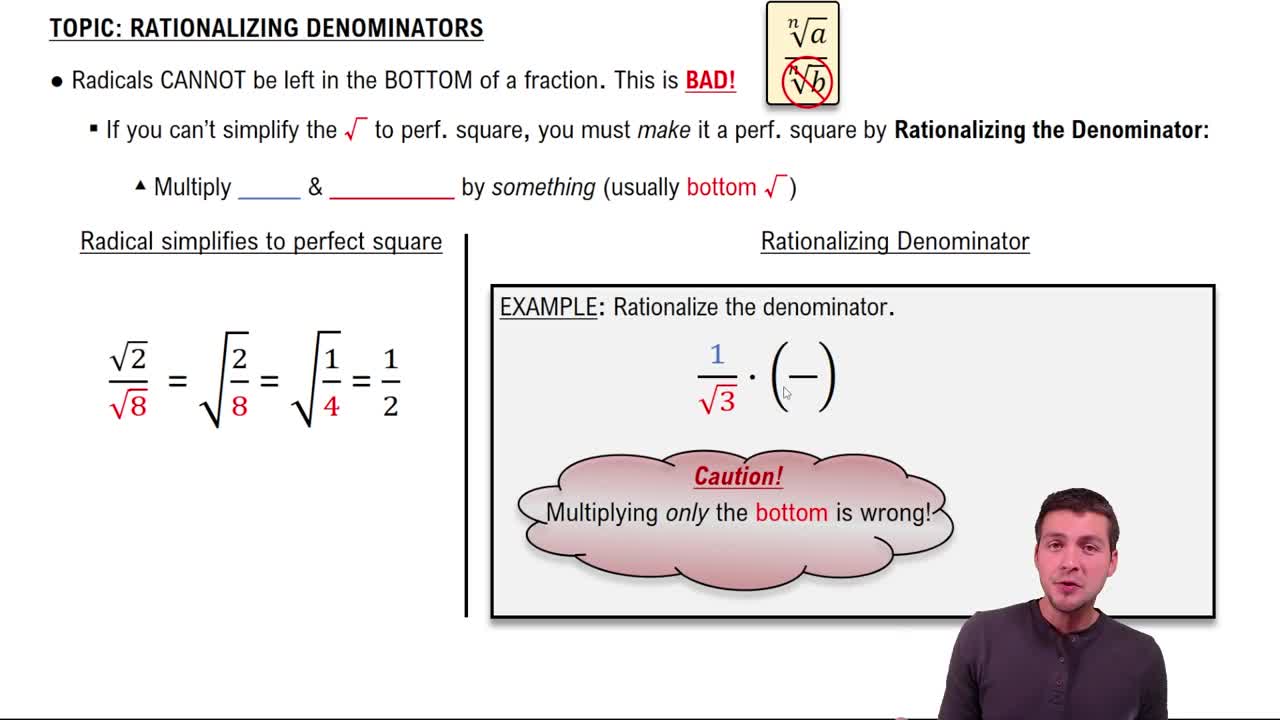
Rationalizing the Denominator

Rationalizing the denominator involves eliminating any irrational numbers, such as square roots, from the denominator of a fraction. This is done by multiplying both the numerator and denominator by a suitable expression that will remove the radical from the denominator.
Recommended video:
Guided course
02:58
Rationalizing Denominators

Properties of Square Roots

Square roots have properties that allow simplification, such as √a × √a = a. Understanding these properties helps in manipulating expressions to rationalize denominators by converting radicals into whole numbers.
Recommended video:
02:20
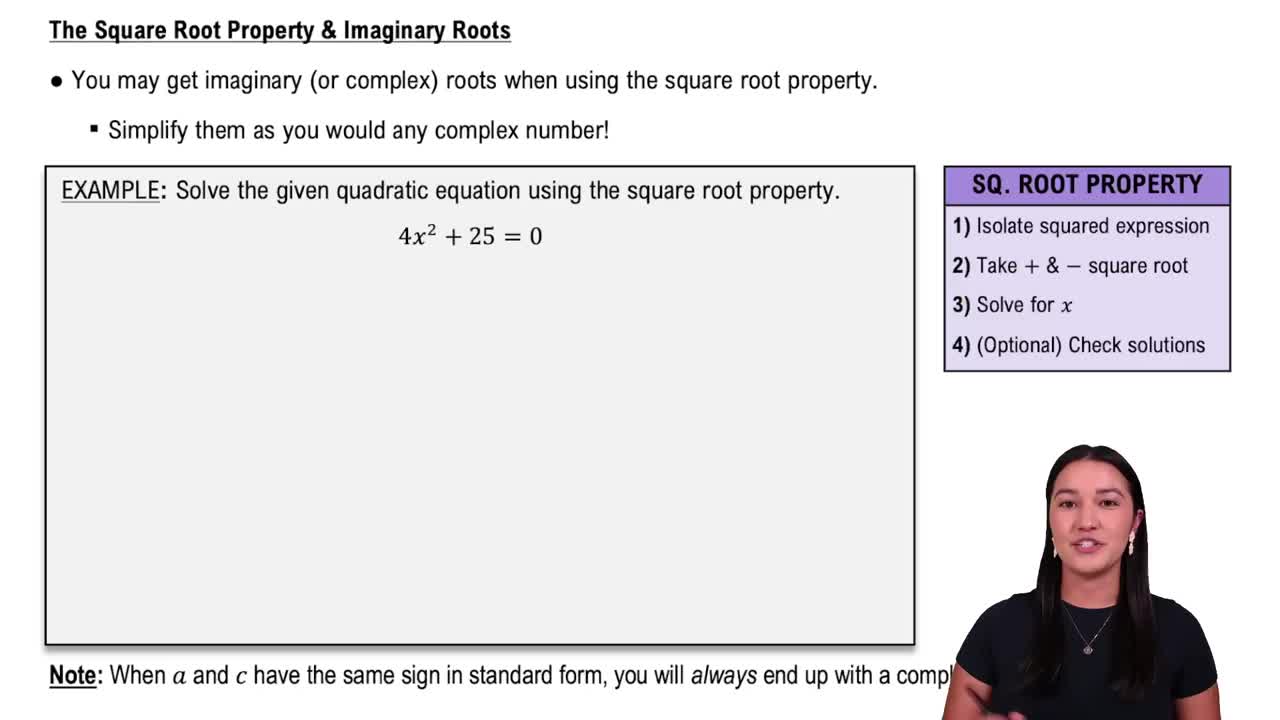
Imaginary Roots with the Square Root Property

Multiplying Fractions by 1

Multiplying a fraction by a form of 1, such as √5/√5, changes the expression without altering its value. This technique is essential for rationalizing denominators because it allows the removal of radicals while keeping the fraction equivalent.
Recommended video:
Guided course
04:15
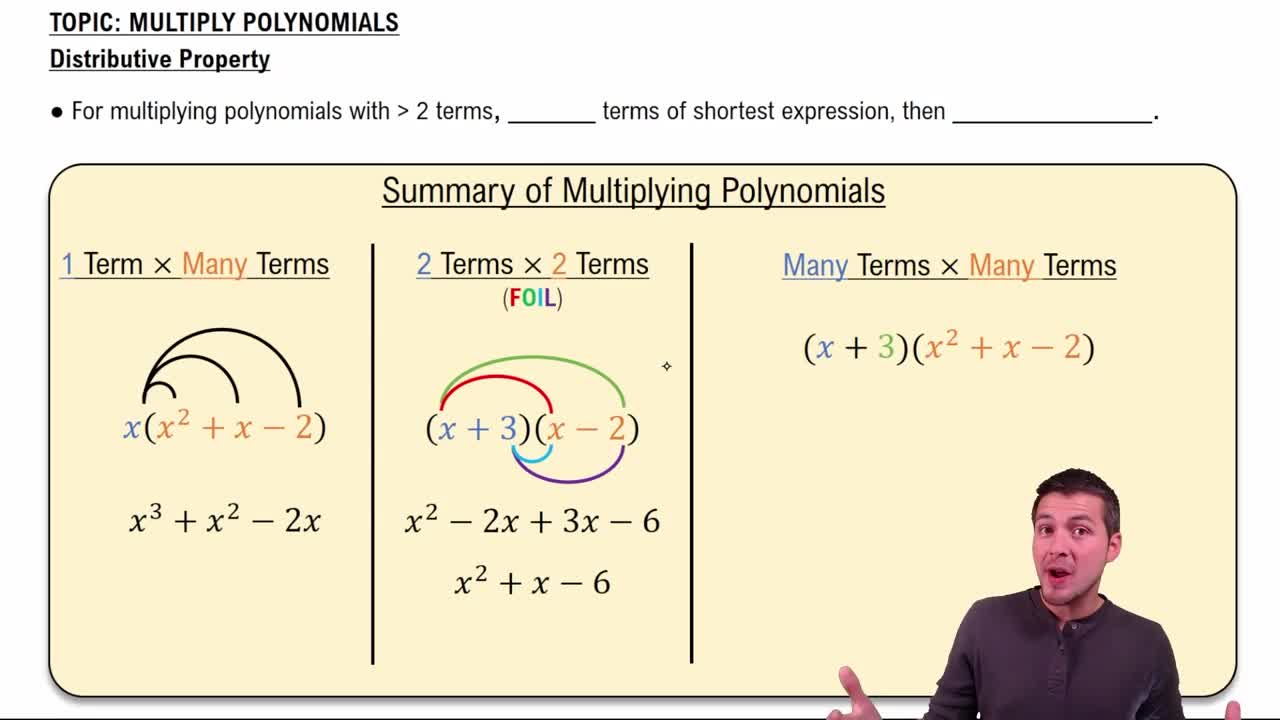
Multiply Polynomials Using the Distributive Property