Use properties of logarithms to expand each logarithmic expression as much as possible. Where possible, evaluate logarithmic expressions without using a calculator. logb (x2 y)
Ch. 4 - Exponential and Logarithmic Functions

Chapter 5, Problem 19
Write each equation in its equivalent logarithmic form. 7y = 200
Verified step by step guidance1
Identify the given exponential equation: \$7^y = 200$.
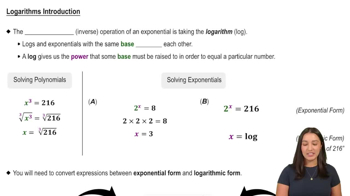
Recall the definition of logarithms: if \(a^x = b\), then the equivalent logarithmic form is \(\log_a b = x\).
In this problem, the base \(a\) is 7, the exponent \(x\) is \(y\), and the result \(b\) is 200.
Rewrite the equation \$7^y = 200$ in logarithmic form using the definition: \(\log_7 200 = y\).
This expresses the original exponential equation as a logarithmic equation, which is the equivalent form requested.

Verified video answer for a similar problem:
This video solution was recommended by our tutors as helpful for the problem above.
Video duration:
1mWas this helpful?
Key Concepts
Here are the essential concepts you must grasp in order to answer the question correctly.
Exponential and Logarithmic Forms
Exponential and logarithmic forms are two ways to express the same relationship. An equation like a^y = b can be rewritten in logarithmic form as log_a(b) = y, where the base a remains the same. Understanding this equivalence is essential for converting between forms.
Recommended video:
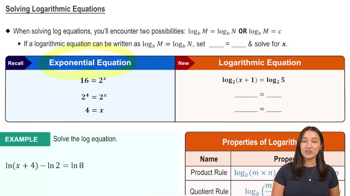
Solving Logarithmic Equations
Definition of a Logarithm
A logarithm answers the question: to what power must the base be raised to produce a given number? For example, log_a(b) = y means a raised to y equals b. This definition is fundamental for rewriting exponential equations as logarithms.
Recommended video:
Logarithms Introduction
Properties of Logarithms
Logarithms have specific properties, such as the base must be positive and not equal to 1, and the argument must be positive. These properties ensure the logarithmic expression is valid and help in correctly rewriting and solving equations.
Recommended video:
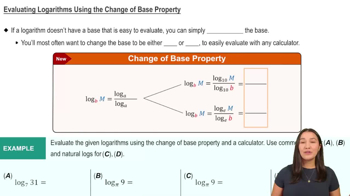
Change of Base Property
Related Practice
Textbook Question
821
views
Textbook Question
In Exercises 19–24, the graph of an exponential function is given. Select the function for each graph from the following options:
1688
views
Textbook Question
Use properties of logarithms to expand each logarithmic expression as much as possible. Where possible, evaluate logarithmic expressions without using a calculator.
876
views
Textbook Question
Solve each exponential equation in Exercises 1–22 by expressing each side as a power of the same base and then equating exponents. e(x+1)=1/e
745
views
Textbook Question
Solve each exponential equation in Exercises 1–22 by expressing each side as a power of the same base and then equating exponents. 8(x+3)=16(x−1)
970
views
Textbook Question
In Exercises 19–29, evaluate each expression without using a calculator. If evaluation is not possible, state the reason. log5 (1/5)
917
views