Skip to main content
General Chemistry
My Course
Learn
Exam Prep
AI Tutor
Study Guides
Textbook Solutions
Flashcards
Explore
My Course
Learn
Exam Prep
AI Tutor
Study Guides
Textbook Solutions
Flashcards
Explore
Back
Boiling Point Elevation quiz
You can tap to flip the card.
Define:
What is boiling point elevation?
You can tap to
flip the card.
👆
What is boiling point elevation?
Boiling point elevation is the phenomenon where adding a solute to a pure solvent increases the boiling point of the solvent.
Track progress
Control buttons has been changed to "navigation" mode.
1/15
Related flashcards
Related practice
Recommended videos
Boiling Point Elevation definitions
Boiling Point Elevation
15 Terms
Boiling Point Elevation quiz
Boiling Point Elevation
10 Terms
Boiling Point Elevation quiz #1
Boiling Point Elevation
18 Terms
Boiling Point Elevation
14. Solutions
4 problems
Topic
Jules
Freezing Point Depression
14. Solutions
4 problems
Topic
Jules
14. Solutions - Part 1 of 3
4 topics
12 problems
Chapter
Jules
14. Solutions - Part 2 of 3
5 topics
12 problems
Chapter
Jules
14. Solutions - Part 3 of 3
5 topics
12 problems
Chapter
Jules
Guided course
03:05
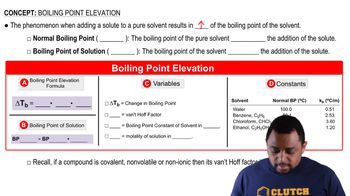
Boiling Point Elevation
Jules Bruno
4119
views
26
rank
Guided course
01:54
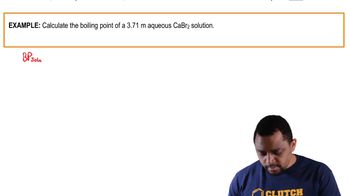
Boiling Point Calculation Example
Jules Bruno
3174
views
26
rank
Terms in this set (15)
Hide definitions
What is boiling point elevation?
Boiling point elevation is the phenomenon where adding a solute to a pure solvent increases the boiling point of the solvent.
What is the normal boiling point of a solvent?
The normal boiling point is the boiling point of the pure solvent before any solute is added.
How does adding more solute affect the boiling point of a solution?
Adding more solute increases the boiling point of the solution.
What is the formula for calculating the change in boiling point (ΔTb)?
The formula is ΔTb = i × Kb × m, where i is the Van't Hoff factor, Kb is the boiling point elevation constant, and m is the molality.
What does the variable 'i' represent in the boiling point elevation formula?
'i' represents the Van't Hoff factor, which accounts for the number of particles the solute produces in solution.
What does 'Kb' stand for in the boiling point elevation equation?
'Kb' is the boiling point elevation constant of the solvent, measured in °C/m.
How is molality (m) defined in the context of boiling point elevation?
Molality is the number of moles of solute per kilogram of solvent.
How do you calculate the boiling point of a solution after adding a solute?
Add the change in boiling point (ΔTb) to the normal boiling point of the pure solvent.
Which common solvents are often used in boiling point elevation problems?
Common solvents include water, benzene, chloroform, and ethanol.
Do you need to memorize the Kb values for common solvents?
No, you do not need to memorize the Kb values; they are usually provided in questions.
What is the Van't Hoff factor for covalent, non-volatile, or non-ionic compounds?
The Van't Hoff factor is 1 for covalent, non-volatile, or non-ionic compounds.
What happens to the boiling point of a solvent when a non-electrolyte solute is added?
The boiling point increases, and the Van't Hoff factor used is 1.
Why does the boiling point of a solution increase when a solute is added?
The presence of solute particles disrupts the solvent's ability to vaporize, requiring a higher temperature to boil.
What units are used for the boiling point elevation constant (Kb)?
Kb is measured in degrees Celsius per molal (°C/m).
What is the relationship between tbe amount of solute and the magnitude of boiling point elevation?
The more solute added, the greater the boiling point elevation.
 BackBack
 03:05
03:05