Back

Mole Concept quiz

Control buttons has been changed to "navigation" mode.
1/15
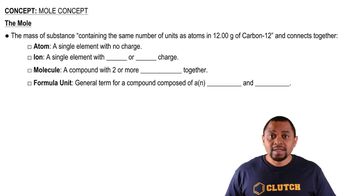
  • What is the formal definition of a mole in chemistry?

    A mole is the amount of substance containing the same number of units as there are atoms in 12 grams of carbon-12.
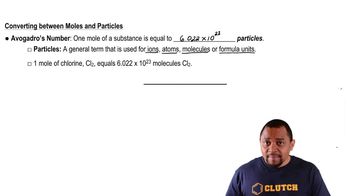
  • What is Avogadro's number and what does it represent?

    Avogadro's number is 6.022 × 10^23, and it represents the number of particles in one mole of a substance.
  • What types of particles can the term 'particles' refer to in chemistry?

    The term 'particles' can refer to atoms, ions, molecules, or formula units.
  • How is the term 'atom' defined in the context of the mole concept?

    An atom is a single element with no charge.
  • What is an ion, and how does it differ from an atom?

    An ion is a single element that possesses a positive or negative charge, unlike an atom which is neutral.
  • How is a molecule defined in the mole concept?

    A molecule is a compound with two or more nonmetals bonded together, which can be the same or different elements.
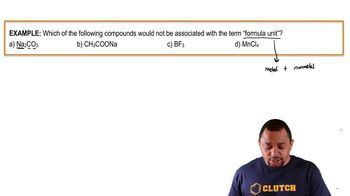
  • What is a formula unit in chemistry?

    A formula unit is a general term for a compound composed of a metal and a nonmetal.
  • Why do we use the term 'molecules' for chlorine gas (Cl2)?

    We use 'molecules' because chlorine gas consists of two nonmetal chlorine atoms bonded together.
  • What is the molar mass of Cl2, and how is it calculated?

    The molar mass of Cl2 is 70.90 grams, calculated by multiplying the atomic mass of chlorine (35.45) by 2.
  • How does the mole act as a bridge in chemical calculations?

    The mole connects the number of particles to the mass of a substance, allowing conversions between these quantities.
  • What is the relationship between moles and mass for a substance?

    One mole of a substance is equal to its molar mass in grams.
  • How can Avogadro's number be used as a conversion factor?

    Avogadro's number allows conversion between moles and the number of particles by using 1 mole = 6.022 × 10^23 particles.
  • When do we use the term 'formula unit' instead of 'molecule'?

    We use 'formula unit' when referring to compounds made of a metal and a nonmetal.
  • What is the significance of the value 35.45 in calculating the molar mass of Cl2?

    35.45 is the atomic mass of one chlorine atom, which is doubled to find the molar mass of Cl2.
  • Why can conversion factors involving moles be flipped in calculations?

    Conversion factors can be flipped to ensure that units cancel appropriately during calculations.