Back

Periodic Table: Classifications quiz

Control buttons has been changed to "navigation" mode.
1/15
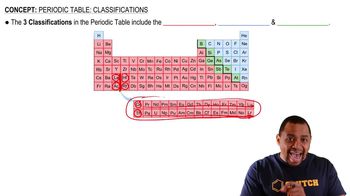
  • What are the three main classifications of elements on the periodic table?

    The three main classifications are metals, nonmetals, and metalloids.
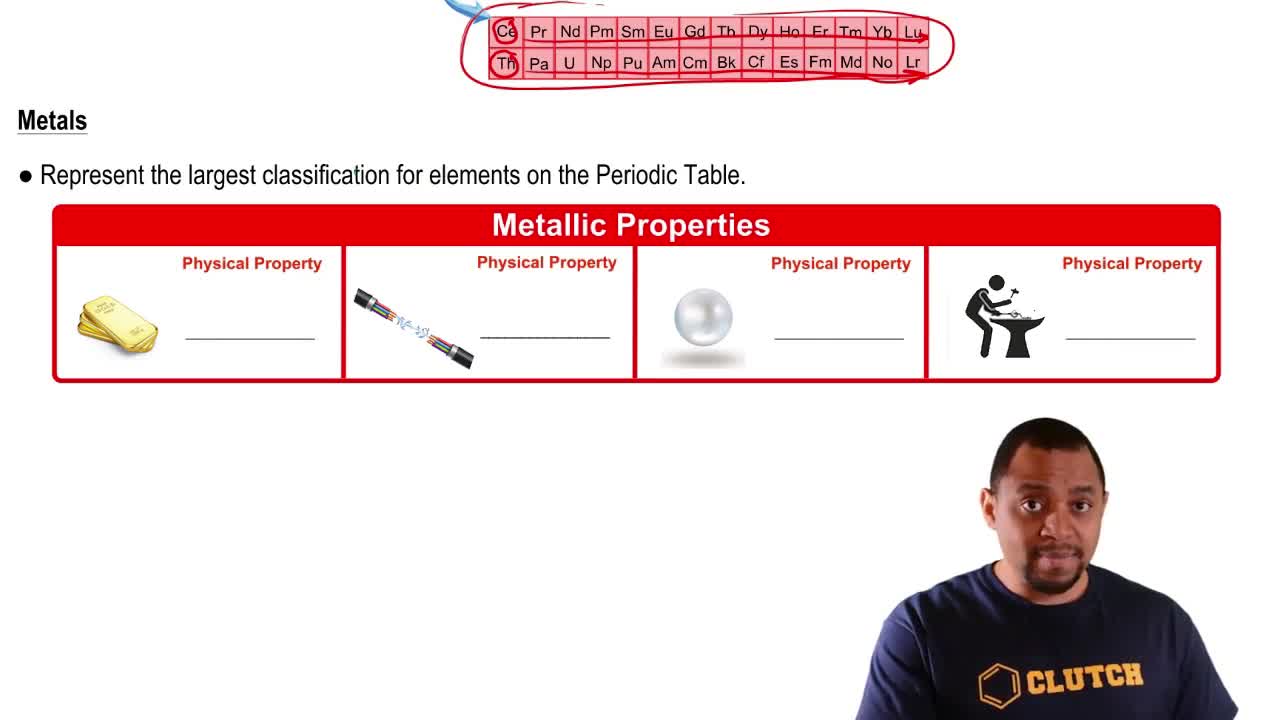
  • Which classification represents the majority of elements on the periodic table?

    Metals represent the largest classification and outnumber nonmetals and metalloids.
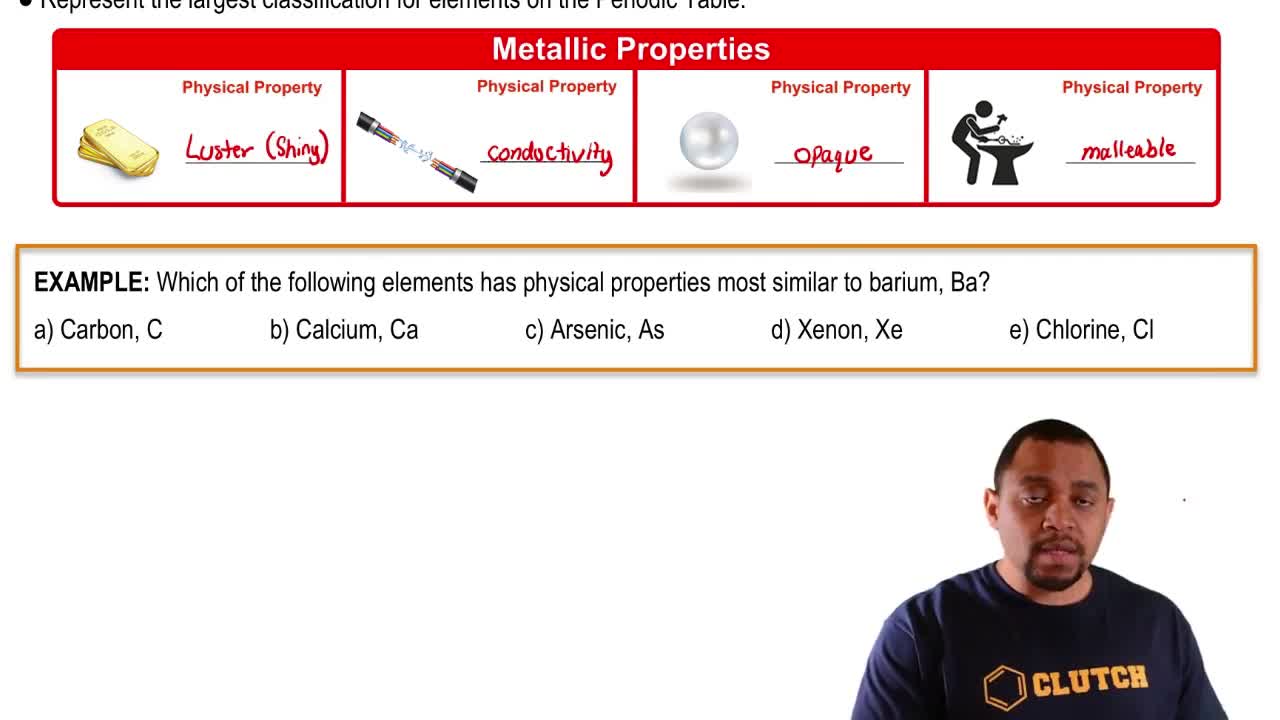
  • What physical property describes the shininess of metals?

    Luster describes the shininess of metals; they are typically very shiny.
  • How do metals conduct electricity compared to nonmetals?

    Metals are good conductors of electricity, while nonmetals are poor conductors.
  • What does it mean for a metal to be malleable?

    Malleability means metals can be hammered into thin sheets or different shapes without breaking.
  • What is the opposite of malleability, commonly seen in nonmetals?

    The opposite of malleability is brittleness; nonmetals are brittle and crumble when hammered.
  • Where are most nonmetals located on the periodic table?

    Most nonmetals are found on the far right side of the periodic table, except for hydrogen.
  • How do the physical properties of nonmetals compare to those of metals?

    Nonmetals generally have opposite properties to metals: they are dull, poor conductors, can be transparent, and are brittle.
  • What is the significance of the 'invisible staircase' on the periodic table?

    The invisible staircase marks the location of metalloids, running from boron to astatine.
  • How many metalloids are there, and can you name two?

    There are seven metalloids; examples include silicon and germanium.
  • What unique property do metalloids possess compared to metals and nonmetals?

    Metalloids have properties of both metals and nonmetals, making them semiconductors.
  • Why is silicon important in technology?

    Silicon is a metalloid and semiconductor, making it ideal for use in computer chips and electronic devices.
  • What does it mean for a metal to be opaque?

    Being opaque means metals are not transparent; you cannot see through them.
  • Which element is a nonmetal but is located on the far left of the periodic table?

    Hydrogen is a nonmetal found on the far left of the periodic table.
  • What real-world application is directly related to the classification of silicon as a metalloid?

    Silicon's classification as a metalloid allows it to be used in microchips for computers and phones.