
The osmotic pressure of a solution containing 2.10 g of an unknown compound dissolved in 175.0 mL of solution at 25 °C is 1.93 atm. The combustion of 24.02 g of the unknown compound produced 28.16 g CO2 and 8.64 g H2O. What is the molecular formula of the compound (which contains only carbon, hydrogen, and oxygen)?
Ch.13 - Solutions
Chapter 13, Problem 123
A 100.0-mL aqueous sodium chloride solution is 13.5% NaCl by mass and has a density of 1.12 g/mL. What would you add (solute or solvent) and what mass of it to make the boiling point of the solution 104.4 °C? (Use i = 1.8 for NaCl.)
Verified step by step guidance1

Verified video answer for a similar problem:
This video solution was recommended by our tutors as helpful for the problem above.
Video duration:
5mWas this helpful?
Key Concepts
Here are the essential concepts you must grasp in order to answer the question correctly.
Colligative Properties
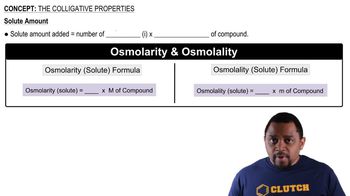
Colligative properties are physical properties of solutions that depend on the number of solute particles in a given amount of solvent, rather than the identity of the solute. These properties include boiling point elevation, freezing point depression, vapor pressure lowering, and osmotic pressure. In this question, the boiling point elevation is crucial for determining how much solute or solvent to add to achieve the desired boiling point.
Recommended video:
Guided course
Colligative Properties
Boiling Point Elevation Formula
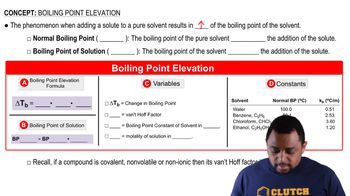
The boiling point elevation can be calculated using the formula ΔT_b = i * K_b * m, where ΔT_b is the change in boiling point, i is the van 't Hoff factor (which accounts for the number of particles the solute dissociates into), K_b is the ebullioscopic constant of the solvent, and m is the molality of the solution. For sodium chloride (NaCl), i is 2 because it dissociates into two ions: Na⁺ and Cl⁻. This formula is essential for calculating how much solute is needed to reach the target boiling point.
Recommended video:
Guided course
Boiling Point Elevation
Density and Mass Calculations
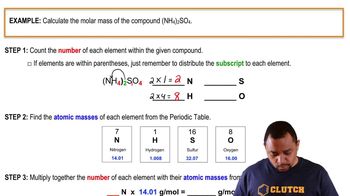
Density is defined as mass per unit volume and is crucial for converting between mass and volume in solution calculations. In this problem, the density of the sodium chloride solution (1.12 g/mL) allows us to determine the mass of the solution from its volume (100.0 mL). Understanding how to manipulate density and mass is vital for calculating the total mass of solute or solvent needed to achieve the desired boiling point.
Recommended video:
Guided course
Molar Mass Calculation Example
Related Practice
Textbook Question
1762
views
Textbook Question
A solution contains 10.05 g of unknown compound dissolved in 50.0 mL of water. (Assume a density of 1.00 g/mL for water.) The freezing point of the solution is -3.16 °C. The mass percent composition of the compound is 60.97% C, 11.94% H, and the rest is O. What is the molecular formula of the compound?
1442
views
Textbook Question
A 50.0-mL solution is initially 1.55% MgCl2 by mass and has a density of 1.05 g/mL. What is the freezing point of the solution after you add an additional 1.35 g MgCl2? (Use i = 2.5 for MgCl2.)
693
views
Textbook Question
Find the mass of urea (CH4N2O) needed to prepare 50.0 g of a solution in water in which the mole fraction of urea is 0.0770.
2342
views
1
comments
