Back
Back
- Complete and balance each combustion reaction equation: a. C(s) + O2(g) → b. C3H8O(l) + O2(g) → c. CS2(s) + O2(g) → d. C4H6(g) + O2(g) →
Problem 1
- Consider the balanced equation: 2 N2H4(g) + N2O4(g) → 3 N2(g) + 4 H2O(g). Complete the table showing the appropriate number of moles of reactants and products. If the number of moles of a reactant is provided, fill in the required amount of the other reactant, as well as the moles of each product that forms. If the number of moles of a product is provided, fill in the required amount of each reactant to make that amount of product, as well as the amount of the other product that forms. Mol N2H4 Mol N2O4 Mol N2 Mol H2O 2 _____ _____ _____ _____ 5 _____ _____ _____ _____ _____ 10 _____ _____ 11.8 _____ 2.5 _____ _____ _____ _____ 4.2 _____ _____
Problem 3
- We prepare a solution by mixing 0.10 L of 0.12 M sodium chloride with 0.23 L of a 0.18 M MgCl2 solution. What volume of a 0.20 M silver nitrate solution is needed to precipitate all the Cl- ions in the solution as AgCl?
Problem 12
- Consider the unbalanced equation for the combustion of hexane: C6H14(g) + O2(g) → CO2(g) + H2O(g). Balance the equation and determine how many moles of O2 are required to react completely with 7.2 moles of C6H14.
Problem 25
Problem 26
Consider the unbalanced equation for the neutralization of acetic acid: HC2H3O2(aq) + Ba(OH)2(aq) → H2O(l) + Ba(C2H3O2)2(aq) Balance the equation and determine how many moles of Ba(OH)2 are required to completely neutralize 0.461 mole of HC2H3O2.
- Calculate how many moles of NO2 form when each quantity of reactant completely reacts. Reaction: 2 N2O5(g) → 4 NO2(g) + O2(g) a. 15.2 g N2O5 b. 6.8 mol N2O5 c. 2.87 kg N2O5
Problem 27
Problem 27a
Calculate how many moles of NO2 form when each quantity of reactant completely reacts. 2 N2O5( g) → 4 NO2(g) + O2(g) a. 2.5 mol N2O5
- Calculate how many moles of NH3 form when each quantity of reactant completely reacts. 3 N2H4(l) → 4 NH3(g) + N2(g), given the following reactant quantities: a. 2.6 mol N2H4, b. 3.55 mol N2H4, c. 4.88 kg N2H4.
Problem 28
Problem 28c
Calculate how many moles of NH3 form when each quantity of reactant completely reacts. 3 N2H4(l) → 4 NH3(g) + N2(g) c. 65.3 g N2H4
Problem 29
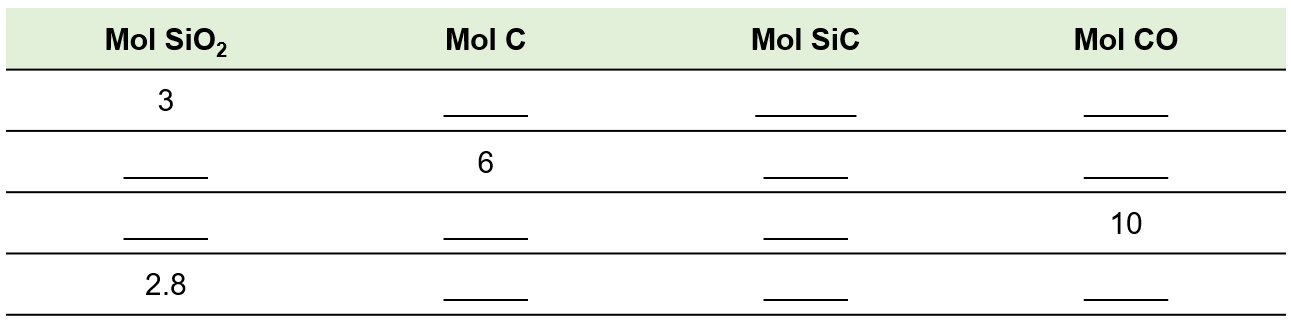
Consider the balanced equation:
SiO2(s) + 3 C(s) → SiC(s) + 2 CO(g)
Complete the table showing the appropriate number of moles of reactants and products. If the number of moles of a reactant is provided, fill in the required amount of the other reactant, as well as the moles of each product that forms. If the number of moles of a product is provided, fill in the required amount of each reactant to make that amount of product, as well as the amount of the other product that forms.
Problem 29e
Consider the balanced equation:
SiO2(s) + 3 C(s) → SiC(s) + 2 CO(g)
Complete the table showing the appropriate number of moles of reactants and products. If the number of moles of a reactant is provided, fill in the required amount of the other reactant, as well as the moles of each product that forms. If the number of moles of a product is provided, fill in the required amount of each reactant to make that amount of product, as well as the amount of the other product that forms.
Problem 31
Hydrobromic acid dissolves solid iron according to the reaction:
Fe(s) + 2 HBr(aq) → FeBr2(aq) + H2(g)
What mass of HBr (in g) do you need to dissolve a 3.2-g pure iron bar on a padlock? What mass of H2 would the complete reaction of the iron bar produce?
Problem 31a
Hydrobromic acid dissolves solid iron according to the reaction:
Fe(s) + 2 HBr(aq) → FeBr2(aq) + H2(g)
What mass of HBr (in g) do you need to dissolve a 3.2-g pure iron bar on a padlock?
Problem 32
Sulfuric acid dissolves aluminum metal according to the reaction:
2 Al(s) + 3 H2SO4(aq) → Al2(SO4)3(aq) + 3 H2( g)
Suppose you want to dissolve an aluminum block with a mass of 15.2 g. What minimum mass of H2SO4 (in g) do you need? What mass of H2 gas (in g) does the complete reaction of the aluminum block produce?
- For each of the reactions, calculate the mass (in grams) of the product that forms when 3.67 g of the underlined reactant completely reacts. Assume that there is more than enough of the other reactant. a. Ba(s) + Cl2(g) → BaCl2(s) b. CaO(s) + CO2(g) → CaCO3(s) c. 2 Mg(s) + O2(g) → 2 MgO(s) d. 4 Al(s) + 3 O2(g) → 2 Al2O3(s)
Problem 33
Problem 34
For each of the reactions, calculate the mass (in grams) of the product that forms when 15.39 g of the underlined reactant completely reacts. Assume that there is more than enough of the other reactant.
a. 2 K(s) + Cl2(g) → 2 KCl(s)
b. 2 K(s) + Br2(l) → 2 KBr(s)
c. 4 Cr(s) + 3 O2(g) → 2 Cr2O3(s)
d. 2 Sr(s) + O2(g) → 2 SrO(s)
Problem 35
For each of the acid–base reactions, calculate the mass (in grams) of each acid necessary to completely react with and neutralize 4.85 g of the base. b. 2 HNO3(aq) + Ca(OH)2(aq) → 2 H2O(l) + Ca(NO3)2(aq)
- For each precipitation reaction, calculate how many grams of the first reactant are necessary to completely react with 55.8 g of the second reactant. a. 2 KI(aq) + Pb(NO3)2(aq) → PbI2(s) + 2 KNO3(aq) b. Na2CO3(aq) + CuCl2(aq) → CuCO3(s) + 2 NaCl(aq) c. K2SO4(aq) + Sr(NO3)2(aq) → SrSO4(s) + 2 KNO3(aq)
Problem 36
Problem 37
Find the limiting reactant for each initial amount of reactants.
2 Na(s) + Br2(g) → 2 NaBr(s)
a. 2 mol Na, 2 mol Br2
b. 1.8 mol Na, 1.4 Br2
c. 2.5 mol Na, 1 mol Br2
d. 12.6 mol Na, 6.9 mol Br2
Problem 38
Find the limiting reactant for each initial amount of reactants. 4 Al(s) + 3 O2( g) → 2 Al2O3(s)
a. 1 mol Al, 1 mol O2
b. 4 mol Al, 2.6 mol O2
c. 16 mol Al, 13 mol O2
d. 7.4 mol Al, 6.5 mol O2
Problem 39b
Consider the reaction: 4 HCl(g) + O2(g) → 2 H2O(g) + 2 Cl2(g) Each molecular diagram represents an initial mixture of reactants. How many molecules of Cl2 form from the reaction mixture that produces the greatest amount of products?
Problem 40
Consider the reaction: 2 CH3OH(g) + 3 O2(g) → 2 CO2(g) + 4 H2O(g) Each of the molecular diagrams represents an initial mixture of the reactants. How many CO2 molecules form from the reaction mixture that produces the greatest amount of products?
Problem 41
Calculate the theoretical yield of the product (in moles) for each initial amount of reactants.
Ti(s) + 2 Cl2(g) → TiCl4(s)
a. 4 mol Ti, 4 mol Cl2
b. 7 mol Ti, 17 mol Cl2
c. 12.4 mol Ti, 18.8 mol Cl2
Problem 42
Calculate the theoretical yield of product (in moles) for each initial amount of reactants.
3 Mn(s) + 2 O2(g) → Mn3O4(s)
a. 3 mol Mn, 2 mol O2
b. 4 mol Mn, 7 mol O2
c. 27.5 mol Mn, 43.8 mol O2
Problem 43
Zinc sulfide reacts with oxygen according to the reaction: 2 ZnS(s) + 3 O2(g) → 2 ZnO(s) + 2 SO2( g) A reaction mixture initially contains 4.2 mol ZnS and 6.8 mol O2. Once the reaction has occurred as completely as possible, what amount (in moles) of the excess reactant remains?
Problem 44
Iron(II) sulfide reacts with hydrochloric acid according to the reaction: FeS(s) + 2 HCl(aq) → FeCl2(s) + H2S(g) A reaction mixture initially contains 0.223 mol FeS and 0.652 mol HCl. Once the reaction has occurred as completely as possible, what amount (in moles) of the excess reactant remains?
Problem 44-
Iron(II) sulfide reacts with hydrochloric acid according to the reaction: FeS(s) + 2 HCl(aq) → FeCl2(s) + H2S(g) A reaction mixture initially contains 0.223 mol FeS and 0.652 mol HCl. Once the reaction has occurred as completely as possible, what amount (in moles) of the excess reactant remains?
- For the reaction shown, calculate the theoretical yield of product (in grams) for each initial amount of reactants. 2 Al(s) + 3 Cl2(g) → 2 AlCl3(s) a. 2.0 g Al, 2.0 g Cl2 b. 7.5 g Al, 24.8 g Cl2
Problem 45
Problem 45c
For the reaction shown, calculate the theoretical yield of product (in grams) for each initial amount of reactants. 2 Al(s) + 3 Cl2(g) → 2 AlCl3(s) c. 0.235 g Al, 1.15 g Cl2
- For the reaction shown, calculate the theoretical yield of the product (in grams) for each initial amount of reactants. Ti(s) + 2 F2(g) → TiF4(s) a. 5.0 g Ti, 5.0 g F2 b. 2.4 g Ti, 1.6 g F2
Problem 46