Skip to main content
Genetics
My Course
Learn
Exam Prep
AI Tutor
Study Guides
Textbook Solutions
Flashcards
Explore
Try the app
My Course
Learn
Exam Prep
AI Tutor
Study Guides
Textbook Solutions
Flashcards
Explore
Try the app
Back
Cancer Mutations definitions
You can tap to flip the card.
Cancer
You can tap to flip the card.
👆
Cancer
Abnormal cell growth and proliferation resulting from accumulated genetic changes disrupting normal cellular controls.
Track progress
Control buttons has been changed to "navigation" mode.
1/14
Related flashcards
Related practice
Recommended videos
Cancer Mutations quiz #1
Cancer Mutations
10 Terms
Cancer Mutations
19. Cancer Genetics
7 problems
Topic
Kylia
Overview of Cancer
19. Cancer Genetics
7 problems
Topic
Kylia
19. Cancer Genetics
2 topics
6 problems
Chapter
Kylia
Guided course
04:46
Cancer Mutations
992
views
8
rank
1
comments
Terms in this set (14)
Hide definitions
Cancer
Abnormal cell growth and proliferation resulting from accumulated genetic changes disrupting normal cellular controls.
Mutation
A permanent alteration in DNA sequence, which can impact cell behavior and contribute to disease if occurring in key genes.
Passenger Mutation
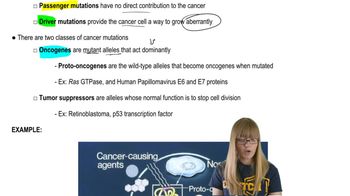
A genetic change present in cancer cells that does not influence tumor development or progression.
Driver Mutation
A genetic alteration that directly contributes to abnormal cell growth, promoting tumor formation.
Oncogene
A mutated gene variant that dominantly promotes uncontrolled cell division, leading to cancerous phenotypes.
Proto-oncogene
A normal gene that, when altered, can become a cancer-promoting variant driving abnormal cell proliferation.
Tumor Suppressor
A gene whose normal function is to inhibit cell division and prevent tumor formation; loss leads to unchecked growth.
Retinoblastoma Protein
A transcription factor that, when functional, prevents eye tumors; its mutation is linked to childhood eye cancer.
p53
A transcription factor regulating many genes; its loss disrupts cell cycle control and enables tumor development.
Transcription Factor
A protein that controls the expression of multiple genes, often influencing cell fate and response to mutations.
Allele
A variant form of a gene, which can be normal or mutated, influencing traits and disease risk.
Recessive Allele
A gene variant whose effect is only seen when both copies in a cell are altered, as in some inherited cancers.
Somatic Cell
A non-reproductive cell where most cancer-related mutations accumulate, not passed to offspring.
Signal Transduction Pathway
A series of molecular events, often involving proteins like Ras, that transmit signals controlling cell behavior.
 BackBack
 04:46
04:46