Skip to main content
Genetics
My Course
Learn
Exam Prep
AI Tutor
Study Guides
Textbook Solutions
Flashcards
Explore
Try the app
My Course
Learn
Exam Prep
AI Tutor
Study Guides
Textbook Solutions
Flashcards
Explore
Try the app
Back
Chromosomal Mutations: Aneuploidy definitions
You can tap to flip the card.
Chromosomal Mutation
You can tap to flip the card.
👆
Chromosomal Mutation
Alteration in chromosome structure or number, impacting genetic balance and potentially causing severe phenotypes.
Track progress
Control buttons has been changed to "navigation" mode.
1/15
Related flashcards
Related practice
Recommended videos
Chromosomal Mutations: Aneuploidy quiz #1
Chromosomal Mutations: Aneuploidy
16 Terms
Chromosomal Mutations: Aneuploidy
6. Chromosomal Variation
7 problems
Topic
Kylia
Chromosomal Rearrangements: Overview
6. Chromosomal Variation
1 problem
Topic
Kylia
6. Chromosomal Variation - Part 1 of 2
5 topics
10 problems
Chapter
Kylia
6. Chromosomal Variation - Part 2 of 2
3 topics
10 problems
Chapter
Kylia
Guided course
09:05
Aneuploidy
1982
views
16
rank
1
comments
Terms in this set (15)
Hide definitions
Chromosomal Mutation
Alteration in chromosome structure or number, impacting genetic balance and potentially causing severe phenotypes.
Aneuploidy
Condition where one or a few chromosomes have abnormal copy numbers, leading to gene imbalance and distinct syndromes.
Aberrant Euploidy
Change involving the entire set of chromosomes, resulting in organisms with abnormal numbers of all chromosome sets.
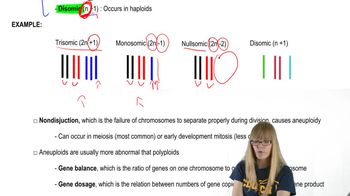
Trisomic
State in diploids with one extra chromosome, often causing disorders like Down syndrome due to gene dosage imbalance.
Monosomic
State in diploids missing one chromosome, exemplified by Turner syndrome, leading to significant genetic imbalance.
Nolesomic
Condition where a diploid organism lacks both copies of a chromosome, resulting in severe genetic consequences.
Disomic
Haploid organism possessing an extra chromosome, disrupting the normal gene balance in single-set genomes.
Nondisjunction
Failure of chromosomes to separate properly during cell division, causing abnormal chromosome numbers in cells.
Meiosis
Cell division process forming gametes, where errors can lead to aneuploidy through improper chromosome segregation.
Mitosis
Cell division process for growth and repair, where early errors can result in mosaic aneuploidy in developing organisms.
Gene Balance
Ratio of genes on one chromosome to another, crucial for normal development and disrupted by aneuploidy.
Gene Dosage
Relationship between gene copy number and gene product amount, with imbalances causing severe phenotypes.
Polyploidy
Presence of extra sets of all chromosomes, generally less harmful than aneuploidy due to maintained gene balance.
Diploid
Organism or cell with two complete sets of chromosomes, serving as the reference state for aneuploidy types.
Haploid
Organism or cell with a single set of chromosomes, used to describe certain aneuploid conditions like disomy.
 BackBack
 09:05
09:05