Skip to main content
Genetics
My Course
Learn
Exam Prep
AI Tutor
Study Guides
Textbook Solutions
Flashcards
Explore
Try the app
My Course
Learn
Exam Prep
AI Tutor
Study Guides
Textbook Solutions
Flashcards
Explore
Try the app
Back
Ribosomal Structure definitions
You can tap to flip the card.
Ribosome
You can tap to flip the card.
👆
Ribosome
RNA-protein complex that translates mRNA into protein, with RNA catalyzing reactions and proteins providing structural support.
Track progress
Control buttons has been changed to "navigation" mode.
1/14
Related flashcards
Related practice
Recommended videos
Ribosomal Structure quiz #1
Ribosomal Structure
10 Terms
Ribosomal Structure
11. Translation
3 problems
Topic
Kylia
Translation
11. Translation
7 problems
Topic
Kylia
11. Translation
5 topics
13 problems
Chapter
Kylia
Guided course
03:49
Ribosome Structure
2098
views
19
rank
1
comments
Terms in this set (14)
Hide definitions
Ribosome
RNA-protein complex that translates mRNA into protein, with RNA catalyzing reactions and proteins providing structural support.
Large Subunit
Component that joins with the small subunit during translation, housing the peptidyl transferase center for peptide bond formation.
Small Subunit
Component that binds mRNA and helps position tRNA for decoding, assembling with the large subunit during translation.
Nucleolus
Nuclear compartment where ribosomal components are assembled before being exported to the cytoplasm.
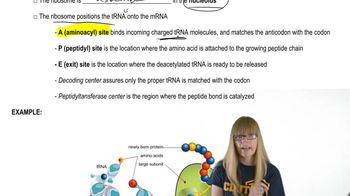
A Site
Region where charged tRNA pairs its anticodon with the mRNA codon, initiating translation.
P Site
Region where the amino acid from tRNA is added to the growing peptide chain during translation.
E Site
Region where uncharged tRNA is released from the ribosome after donating its amino acid.
Decoding Center
Region ensuring correct pairing between tRNA anticodon and mRNA codon at the A site.
Peptidyl Transferase Center
Region catalyzing peptide bond formation between the new amino acid and the growing polypeptide chain.
mRNA
Molecule carrying genetic instructions from DNA, serving as the template for protein synthesis in the ribosome.
tRNA
Adaptor molecule with an anticodon that brings specific amino acids to the ribosome during translation.
Anticodon
Three-nucleotide sequence on tRNA that pairs with the complementary codon on mRNA.
Codon
Three-nucleotide sequence on mRNA specifying which amino acid will be added during translation.
Peptide Chain
Growing sequence of amino acids formed during translation, ultimately folding into a functional protein.
 BackBack
 03:49
03:49