
One form of posttranscriptional modification of most eukaryotic pre-mRNAs is the addition of a poly-A sequence at the 3' end. The absence of a poly-A sequence leads to rapid degradation of the transcript. Poly-A sequences of various lengths are also added to many bacterial RNA transcripts where, instead of promoting stability, they enhance degradation. In both cases, RNA secondary structures, stabilizing proteins, or degrading enzymes interact with poly-A sequences. Considering the activities of RNAs, what might be general functions of 3'-polyadenylation?
Shown here are the amino acid sequences of the wild-type and three mutant forms of a short protein.
___________________________________________________
Wild-type: Met-Trp-Tyr-Arg-Gly-Ser-Pro-Thr
Mutant 1: Met-Trp
Mutant 2: Met-Trp-His-Arg-Gly-Ser-Pro-Thr
Mutant 3: Met-Cys-Ile-Val-Val-Val-Gln-Hi
___________________________________________________
Use this information to answer the following questions:
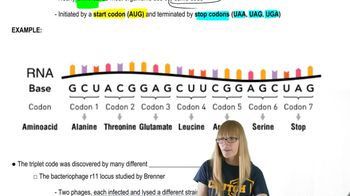
For each mutant protein, determine the specific ribonucleotide change that led to its synthesis.
Verified step by step guidance
Verified video answer for a similar problem:
Key Concepts
Genetic Code and Codon-Amino Acid Relationship
Types of Mutations and Their Effects on Protein Sequence
Translation Termination and Its Impact on Protein Length
In a mixed copolymer experiment, messages were created with either 4/5C:1/5A or 4/5A:1/5C. These messages yielded proteins with the following amino acid compositions.
Using these data, predict the most specific coding composition for each amino acid.
Shown here are the amino acid sequences of the wild-type and three mutant forms of a short protein.
___________________________________________________
Wild-type: Met-Trp-Tyr-Arg-Gly-Ser-Pro-Thr
Mutant 1: Met-Trp
Mutant 2: Met-Trp-His-Arg-Gly-Ser-Pro-Thr
Mutant 3: Met-Cys-Ile-Val-Val-Val-Gln-His _
Use this information to answer the following questions:
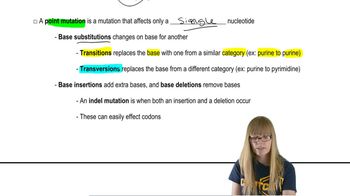
Using the genetic coding dictionary, predict the type of mutation that led to each altered protein.
Shown here are the amino acid sequences of the wild-type and three mutant forms of a short protein.
__________________________________________________
Wild-type: Met-Trp-Tyr-Arg-Gly-Ser-Pro-Thr
Mutant 1: Met-Trp
Mutant 2: Met-Trp-His-Arg-Gly-Ser-Pro-Thr
Mutant 3: Met -Cys-Ile-Val-Val-Val-Gln-His
______________________________________________
Use this information to answer the following questions:
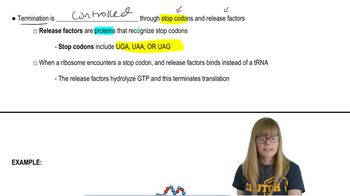
The wild-type RNA consists of nine triplets. What is the role of the ninth triplet?
Shown here are the amino acid sequences of the wild-type and three mutant forms of a short protein.
___________________________________________________
Wild-type: Met-Trp-Tyr-Arg-Gly-Ser-Pro-Thr
Mutant 1: Met-Trp
Mutant 2: Met-Trp-His-Arg-Gly-Ser-Pro-Thr
Mutant 3: Met-Cys-Ile-Val-Val-Val-Gln-Hi
___________________________________________________
Use this information to answer the following questions:
Of the first eight wild-type triplets, which, if any, can you determine specifically from an analysis of the mutant proteins? In each case, explain why or why not.
Shown here are the amino acid sequences of the wild-type and three mutant forms of a short protein.
___________________________________________________
Wild-type: Met-Trp-Tyr-Arg-Gly-Ser-Pro-Thr
Mutant 1: Met-Trp
Mutant 2: Met-Trp-His-Arg-Gly-Ser-Pro-Thr
Mutant 3: Met -Cys-Ile-Val-Val-Val-Gln-His
___________________________________________________
Use this information to answer the following questions:
Another mutation (mutant 4) is isolated. Its amino acid sequence is unchanged from the wild type, but the mutant cells produce abnormally low amounts of the wild-type proteins. As specifically as you can, predict where this mutation exists in the gene.
