
Pearson+ LogoPearson+ Logo
Ch. 14 - Gene Mutation, DNA Repair, and Transposition
Klug - Essentials of Genetics 10th Edition
Klug10th EditionEssentials of GeneticsISBN: 9780135588789Not the one you use?Change textbook
Chapter 14, Problem 21

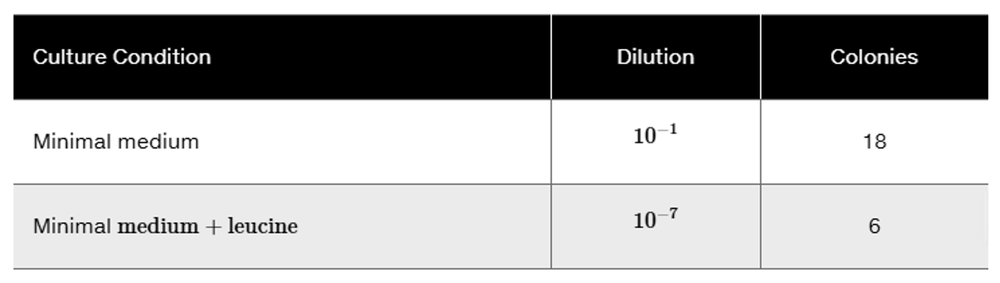
In a bacterial culture in which all cells are unable to synthesize leucine (leu⁻), a potent mutagen is added, and the cells are allowed to undergo one round of replication. At that point, samples are taken, a series of dilutions are made, and the cells are plated on either minimal medium or minimal medium containing leucine. The first culture condition (minimal medium) allows the growth of only leu⁺ cells, while the second culture condition (minimal medium with leucine added) allows growth of all cells. The results of the experiment are as follows:
Table showing bacterial colony counts: 18 colonies at 10⁻¹ dilution on minimal medium, 6 colonies at 10⁻⁷ dilution on minimal medium plus leucine.
What is the rate of mutation at the locus associated with leucine biosynthesis?

Verified step by step guidance
1
Identify the two types of colonies counted: colonies on minimal medium represent the number of \( leu^{+} \) revertants (mutants that regained the ability to synthesize leucine), while colonies on minimal medium plus leucine represent the total viable cells.
Calculate the number of \( leu^{+} \) revertant cells per mL by adjusting for the dilution factor using the formula: \[ \text{Revertant cells per mL} = \frac{\text{Number of colonies on minimal medium}}{\text{Dilution factor}} \] In this case, the dilution factor is \( 10^{-1} \).
Calculate the total number of viable cells per mL by adjusting for the dilution factor for the colonies grown on minimal medium plus leucine: \[ \text{Total viable cells per mL} = \frac{\text{Number of colonies on minimal medium + leucine}}{\text{Dilution factor}} \] Here, the dilution factor is \( 10^{-7} \).
Determine the mutation rate at the leucine biosynthesis locus by dividing the number of revertant cells per mL by the total viable cells per mL: \[ \text{Mutation rate} = \frac{\text{Revertant cells per mL}}{\text{Total viable cells per mL}} \]
Interpret the mutation rate as the frequency of mutations that restore leucine synthesis ability in the bacterial population after one round of replication in the presence of the mutagen.

Verified video answer for a similar problem:

This video solution was recommended by our tutors as helpful for the problem above.
Video duration:
1m
Was this helpful?

Key Concepts

Here are the essential concepts you must grasp in order to answer the question correctly.

Mutation Rate Calculation

Mutation rate is the frequency at which a specific mutation occurs in a given population or number of cells. It is often calculated by dividing the number of mutant colonies by the total number of viable cells, adjusted for dilution factors. Understanding how to interpret colony counts on selective and non-selective media is essential for accurate calculation.
Recommended video:
Guided course
10:48
Mutations and Phenotypes

Selective and Non-Selective Media in Microbial Genetics

Selective media allow growth of only certain genotypes, such as mutants that can synthesize leucine (leu⁺), while non-selective media support growth of all cells regardless of genotype. Comparing colony counts on these media helps identify the number of mutants versus total viable cells, which is critical for mutation rate determination.
Recommended video:
Guided course
05:54
Natural Selection

Role of Dilution in Microbial Colony Counting

Dilution is used to reduce cell concentration to a countable number of colonies on plates. The dilution factor must be accounted for when calculating the original number of cells or mutants in the culture. Accurate interpretation of dilution factors ensures correct estimation of mutation frequency from colony counts.
Recommended video:
Guided course
06:04
Mapping Bacteriophages
Related Practice
Textbook Question

Compare DNA transposons and retrotransposons. What properties do they share?

1262
views
Textbook Question

In maize, a Ds or Ac transposon can alter the function of genes at or near the site of transposon insertion. It is possible for these elements to transpose away from their original insertion site, causing a reversion of the mutant phenotype. In some cases, however, even more severe phenotypes appear, due to events at or near the mutant allele. What might be happening to the transposon or the nearby gene to create more severe mutations?

429
views
Textbook Question

It is estimated that about 0.2 percent of human mutations are due to TE insertions, and a much higher degree of mutational damage is known to occur in some other organisms. In what way might a TE insertion contribute positively to evolution?

442
views
Textbook Question

Presented here are hypothetical findings from studies of heterokaryons formed from seven human xeroderma pigmentosum cell strains:

These data are measurements of the occurrence or nonoccurrence of unscheduled DNA synthesis in the fused heterokaryon. None of the strains alone shows any unscheduled DNA synthesis. Which strains fall into the same complementation groups? How many different groups are revealed based on these data? What can we conclude about the genetic basis of XP from these data?

620
views
Textbook Question

Skin cancer carries a lifetime risk nearly equal to that of all other cancers combined. Following is a graph [modified from K. H. Kraemer (1997). Proc. Natl. Acad. Sci. (USA) 94:11 14] depicting the age of onset of skin cancers in patients with or without XP, where the cumulative percentage of skin cancer is plotted against age. The non-XP curve is based on 29,757 cancers surveyed by the National Cancer Institute, and the curve representing those with XP is based on 63 skin cancers from the Xeroderma Pigmentosum Registry.

Provide an overview of the information contained in the graph. 

677
views
Textbook Question

Skin cancer carries a lifetime risk nearly equal to that of all other cancers combined. Following is a graph [modified from K. H. Kraemer (1997). Proc. Natl. Acad. Sci. (USA) 94:11 14] depicting the age of onset of skin cancers in patients with or without XP, where the cumulative percentage of skin cancer is plotted against age. The non-XP curve is based on 29,757 cancers surveyed by the National Cancer Institute, and the curve representing those with XP is based on 63 skin cancers from the Xeroderma Pigmentosum Registry.

Explain why individuals with XP show such an early age of onset.

491
views