Pearson+ LogoPearson+ Logo
Ch. 4 - Modification of Mendelian Ratios
Klug - Essentials of Genetics 10th Edition
Klug10th EditionEssentials of GeneticsISBN: 9780135588789Not the one you use?Change textbook
Chapter 4, Problem 22

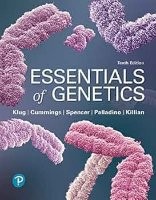
Labrador retrievers may be black, brown (chocolate), or golden (yellow) in color (see chapter-opening photo). While each color may breed true, many different outcomes are seen when numerous litters are examined from a variety of matings where the parents are not necessarily true breeding. Following are just some of the many possibilities.
(a) black x brown → all black
(b) black x brown → 1/2 black, 1/2 brown
(c) black x brown → 3/4 black, 1/4 golden
(d) black x golden → all black
(e) black x golden → 4/8 golden 3/8 black 1/8 brown
(f) black x golden → 2/4 golden 1/4 black 1/4 brown
(g) brown x brown → 3/4 brown 1/4 golden
(h) black x black → 9/16 black 4/16 golden, 3/16 brown
Propose a mode of inheritance that is consistent with these data, and indicate the corresponding genotypes of the parents in each mating. Indicate as well the genotypes of dogs that breed true for each color.

Verified step by step guidance
1
Step 1: Identify the genes involved and their alleles. Labrador coat color is controlled primarily by two genes: the B gene (with alleles B for black and b for brown) and the E gene (with alleles E for pigment expression and e for no pigment expression, which results in yellow/golden color). The B gene determines black or brown pigment, and the E gene controls whether pigment is deposited in the coat.
Step 2: Assign genotypes to each color phenotype based on the known genetics: black Labradors have at least one dominant B allele and at least one dominant E allele (genotypes like B_E_), brown Labradors are homozygous recessive for the B gene (bb) but have at least one dominant E allele (bbE_), and golden/yellow Labradors are homozygous recessive for the E gene (ee), regardless of B gene alleles (B_ee or bbee). Dogs that breed true for each color are homozygous at the relevant loci: black (BBEE or BBEe), brown (bbEE or bbEe), and golden (any B genotype with ee).
Step 3: Analyze each mating scenario by combining the parental genotypes and using Punnett squares for both B and E genes separately, then combine the results to predict offspring genotypes and phenotypes. For example, in a black x brown mating, if the black parent is BbEe and the brown parent is bbee, calculate the possible gametes and resulting offspring genotypes.
Step 4: For each cross, determine the expected phenotypic ratios by considering the dominance relationships: B > b for pigment color, and E > e for pigment expression. Use the combined genotypes to predict the proportion of black, brown, and golden puppies.
Step 5: Match the predicted phenotypic ratios from your genotype crosses to the observed data in the problem (a) through (h). Adjust parental genotypes if necessary to fit the observed ratios, and clearly indicate the genotypes of the parents and the genotypes of puppies that breed true for each color.

Verified video answer for a similar problem:

This video solution was recommended by our tutors as helpful for the problem above.
Video duration:
4m
Was this helpful?

Key Concepts

Here are the essential concepts you must grasp in order to answer the question correctly.

Mendelian Inheritance and Allelic Dominance

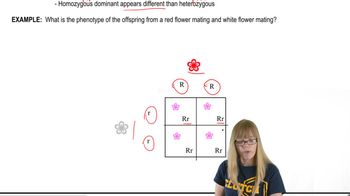
Mendelian inheritance explains how traits are passed from parents to offspring through dominant and recessive alleles. Dominant alleles mask the expression of recessive ones in heterozygotes, affecting phenotype ratios. Understanding dominance relationships among alleles is crucial to predict offspring colors in Labrador retrievers.
Recommended video:
Guided course
04:37
Variations on Dominance

Multiple Alleles and Genotype-Phenotype Relationships

Multiple alleles refer to more than two alternative forms of a gene existing in a population, each potentially producing different phenotypes. In Labradors, coat color is controlled by multiple alleles with a hierarchy of dominance, influencing the observed color ratios. Identifying genotypes that breed true helps clarify which alleles are homozygous and their dominance order.
Recommended video:
Guided course
05:54
Natural Selection

Punnett Squares and Probability in Genetic Crosses

Punnett squares are tools used to predict the genotypic and phenotypic outcomes of genetic crosses by combining parental alleles. They help calculate expected ratios of offspring traits based on allele combinations. Applying Punnett squares to the given crosses allows determination of parental genotypes and consistency with observed color distributions.
Recommended video:
Related Practice
Textbook Question

Consider the three pedigrees below, all involving a single human trait.

Which combination of conditions, if any, can be excluded? dominant and X-linked dominant and autosomal recessive and X-linked recessive and autosomal

623
views
Textbook Question

Consider the three pedigrees below, all involving a single human trait.

For each combination that you excluded, indicate the single individual in generation II (e.g., II-1, II-2) that was most instrumental in your decision to exclude it. If none were excluded, answer 'none apply.'

572
views
Textbook Question

Consider the three pedigrees below, all involving a single human trait.

Given your conclusions in part (a), indicate the genotype of the following individuals: II-1, II-6, II-9 If more than one possibility applies, list all possibilities. Use the symbols A and a for the genotypes.

1023
views
Textbook Question

Horses can be cremello (a light cream color), chestnut (a brownish color), or palomino (a golden color with white in the horse's tail and mane). Of these phenotypes, only palominos never breed true.

From the results given above, determine the mode of inheritance by assigning gene symbols and indicating which genotypes yield which phenotypes.

1086
views
Textbook Question

Horses can be cremello (a light cream color), chestnut (a brownish color), or palomino (a golden color with white in the horse's tail and mane). Of these phenotypes, only palominos never breed true.

Predict the F1 and F2 results of many initial matings between cremello and chestnut horses.

546
views