Pearson+ LogoPearson+ Logo
Ch. 1 - The Molecular Basis of Heredity, Variation, and Evolution
Sanders - Genetic Analysis: An Integrated Approach 3rd Edition
Sanders3rd EditionGenetic Analysis: An Integrated ApproachISBN: 9780135564172Not the one you use?Change textbook
Chapter 1, Problem 21

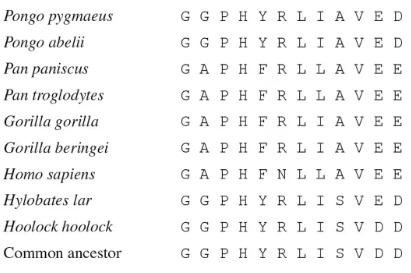
Using the following amino acid sequences obtained from different species of apes, construct a phylogenetic tree of the apes.
Amino acid sequences from various ape species arranged to aid in constructing a phylogenetic tree.

Verified step by step guidance
1
Start by aligning the amino acid sequences from the different species of apes. Use a sequence alignment tool (e.g., ClustalW or MUSCLE) to identify conserved regions and differences among the sequences.
Calculate the pairwise sequence differences or similarities between each pair of species. This can be done by counting the number of mismatched amino acids in the aligned sequences.
Convert the pairwise differences into a distance matrix. The distance matrix will represent the evolutionary distances between the species based on their amino acid sequence differences.
Use the distance matrix to construct the phylogenetic tree. Apply a tree-building algorithm such as the Neighbor-Joining method or UPGMA (Unweighted Pair Group Method with Arithmetic Mean) to infer the relationships among the species.
Visualize the phylogenetic tree. Label the branches with the species names and ensure the branch lengths reflect the evolutionary distances calculated from the distance matrix.

Verified video answer for a similar problem:

This video solution was recommended by our tutors as helpful for the problem above.
Video duration:
4m
Was this helpful?

Key Concepts

Here are the essential concepts you must grasp in order to answer the question correctly.

Amino Acid Sequences

Amino acid sequences are the linear arrangements of amino acids in a protein, determined by the genetic code. These sequences can vary between species, reflecting evolutionary relationships. By comparing these sequences, scientists can infer how closely related different species are, which is essential for constructing phylogenetic trees.
Recommended video:
Guided course
08:41
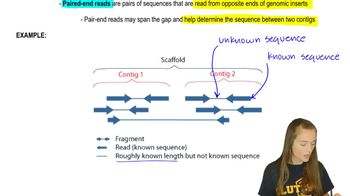
Sequencing Difficulties

Phylogenetic Tree

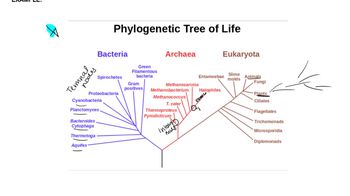
A phylogenetic tree is a diagram that represents the evolutionary relationships among various biological species based on their genetic characteristics. The branches of the tree illustrate how species diverged from common ancestors over time. Constructing a phylogenetic tree involves analyzing genetic data, such as amino acid sequences, to determine the order and timing of evolutionary events.
Recommended video:
Guided course
08:16
Phylogenetic Trees

Molecular Phylogenetics

Molecular phylogenetics is the study of evolutionary relationships using molecular data, primarily DNA, RNA, and protein sequences. This approach allows for more precise insights into the evolutionary history of organisms compared to morphological data alone. By applying statistical methods to molecular data, researchers can construct and validate phylogenetic trees that depict the genetic divergence among species.
Recommended video:
Guided course
08:16
Phylogenetic Trees