Pearson+ LogoPearson+ Logo
Ch. 10 - Eukaryotic Chromosome Abnormalities and Molecular Organization
Sanders - Genetic Analysis: An Integrated Approach 3rd Edition
Sanders3rd EditionGenetic Analysis: An Integrated ApproachISBN: 9780135564172Not the one you use?Change textbook
Chapter 10, Problem 12d

A pair of homologous chromosomes in Drosophila has the following content (single letters represent genes):
Chromosome 1RNMDHBGKWU
Chromosome 2RNMDHBDHBGKWU
How does the pairing diagrammed in part (b) differ from the pairing of chromosomes in an inversion heterozygote?

Verified step by step guidance
1
Examine the given chromosome sequences: Chromosome 1 (RNMDHBGKWU) and Chromosome 2 (RNMDHBDHBGKWU). Note that Chromosome 2 contains a duplication of the segment 'DHBG'.
Understand the concept of an inversion heterozygote: In an inversion heterozygote, one homologous chromosome contains a segment that has been inverted (flipped in orientation) compared to the other homologous chromosome.
Compare the given pairing to an inversion heterozygote: In the given pairing, the difference is due to a duplication of a segment ('DHBG') in Chromosome 2, not an inversion. In an inversion heterozygote, the homologous chromosomes would align with a loop structure to accommodate the inverted segment.
Describe the structural difference: In the given pairing, the chromosomes align without forming a loop because the difference is a duplication, not an inversion. In contrast, an inversion heterozygote would require a loop to align the inverted segment with its homologous counterpart.
Conclude the comparison: The pairing in the given problem differs from an inversion heterozygote because it involves a duplication rather than an inversion. The structural adjustment (loop formation) seen in inversion heterozygotes is not necessary here.

Verified video answer for a similar problem:

This video solution was recommended by our tutors as helpful for the problem above.
Video duration:
2m
Was this helpful?

Key Concepts

Here are the essential concepts you must grasp in order to answer the question correctly.

Homologous Chromosomes

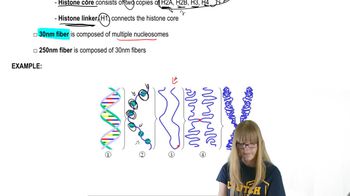
Homologous chromosomes are pairs of chromosomes in a diploid organism that have the same genes at the same loci but may carry different alleles. In Drosophila, these chromosomes can undergo various structural changes, including inversions, which can affect gene expression and pairing during meiosis.
Recommended video:
Guided course
07:10
Chromosome Structure

Inversion Heterozygote

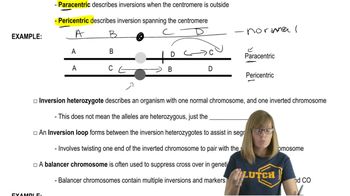
An inversion heterozygote is an individual that has one normal chromosome and one chromosome with a segment inverted. This structural alteration can disrupt normal pairing during meiosis, leading to potential issues in gamete formation, such as the production of unbalanced gametes due to improper crossing over.
Recommended video:

Meiotic Pairing

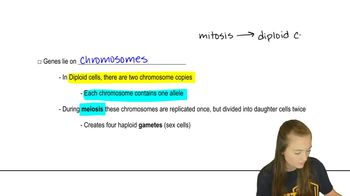
Meiotic pairing refers to the alignment of homologous chromosomes during meiosis, which is crucial for accurate segregation of genetic material. In the presence of inversions, the pairing may be altered, leading to unique configurations that can affect genetic recombination and the viability of gametes.
Recommended video:
Guided course
27:36
Diploid Genetics
Related Practice
Textbook Question

A pair of homologous chromosomes in Drosophila has the following content (single letters represent genes):

Chromosome 1RNMDHBGKWU

Chromosome 2RNMDHBDHBGKWU

What term best describes this situation?

545
views
Textbook Question

A pair of homologous chromosomes in Drosophila has the following content (single letters represent genes):

Chromosome 1RNMDHBGKWU

Chromosome 2RNMDHBDHBGKWU

Diagram the pairing of these homologous chromosomes in prophase I.

383
views
Textbook Question

A pair of homologous chromosomes in Drosophila has the following content (single letters represent genes):

Chromosome 1RNMDHBGKWU

Chromosome 2RNMDHBDHBGKWU

What term best describes the unusual structure that forms during pairing of these chromosomes?

431
views
Textbook Question

An animal heterozygous for a reciprocal balanced translocation has the following chromosomes:

      MN • OPQRST

      MN • OPQRjkl

      cdef • ghijkl

      cdef • ghiST

Diagram the pairing of these chromosomes in prophase I.

450
views
Textbook Question

An animal heterozygous for a reciprocal balanced translocation has the following chromosomes:

      MN • OPQRST

      MN • OPQRjkl

      cdef • ghijkl

      cdef • ghiST

Identify the gametes produced by alternate segregation. Which, if any, of these gametes are viable?

518
views
Textbook Question

An animal heterozygous for a reciprocal balanced translocation has the following chromosomes:

      MN • OPQRST

      MN • OPQRjkl

      cdef • ghijkl

      cdef • ghiST

Identify the gametes produced by adjacent-1 segregation. Which, if any, of these gametes are viable?

497
views