Pearson+ LogoPearson+ Logo
Ch. 5 - Genetic Linkage and Mapping in Eukaryotes
Sanders - Genetic Analysis: An Integrated Approach 3rd Edition
Sanders3rd EditionGenetic Analysis: An Integrated ApproachISBN: 9780135564172Not the one you use?Change textbook
Chapter 5, Problem 6a

In Drosophila, the map positions of genes are given in map units numbering from one end of a chromosome to the other. The X chromosome of Drosophila is 66 m.u. long. The X-linked gene for body color—with two alleles, y⁺ for gray body and y for yellow body—resides at one end of the chromosome at map position 0.0. A nearby locus for eye color, with alleles w⁺ for red eye and w for white eye, is located at map position 1.5. A third X-linked gene, controlling bristle form, with f⁺ for normal bristles and f for forked bristles, is located at map position 56.7. At each locus the wild-type allele is dominant over the mutant allele.


In a cross involving these three X-linked genes, do you expect any gene pair(s) to show genetic linkage? Explain your reasoning.

Verified step by step guidance
1
Understand the concept of genetic linkage: Genetic linkage occurs when two genes are located close to each other on the same chromosome, reducing the likelihood of recombination between them during meiosis. The closer the genes are, the stronger the linkage.
Identify the map positions of the three genes: The body color gene (y⁺/y) is at position 0.0, the eye color gene (w⁺/w) is at position 1.5, and the bristle form gene (f⁺/f) is at position 56.7 on the X chromosome.
Calculate the distances between each pair of genes: Subtract the map positions to determine the genetic distances. For example, the distance between the body color gene and the eye color gene is |1.5 - 0.0| = 1.5 m.u., and the distance between the eye color gene and the bristle form gene is |56.7 - 1.5| = 55.2 m.u.
Evaluate the likelihood of genetic linkage: Genes that are less than 50 m.u. apart are more likely to show genetic linkage because recombination is less frequent. In this case, the body color gene and the eye color gene are only 1.5 m.u. apart, so they are likely to show genetic linkage. However, the bristle form gene is much farther away from both the body color gene (56.7 m.u.) and the eye color gene (55.2 m.u.), so it is unlikely to show linkage with either of them.
Conclude which gene pairs are linked: Based on the distances, the body color gene and the eye color gene are expected to show genetic linkage due to their close proximity, while the bristle form gene is not expected to be linked to either of the other two genes because it is too far away.

Verified video answer for a similar problem:

This video solution was recommended by our tutors as helpful for the problem above.
Video duration:
2m
Was this helpful?

Key Concepts

Here are the essential concepts you must grasp in order to answer the question correctly.

Genetic Linkage

Genetic linkage refers to the tendency of genes located close to each other on the same chromosome to be inherited together during meiosis. This occurs because linked genes are less likely to be separated by recombination events. The closer the genes are on the chromosome, the stronger the linkage, which can be measured in map units (m.u.). In the context of Drosophila, understanding linkage helps predict the inheritance patterns of traits controlled by these genes.
Recommended video:
Guided course
07:33
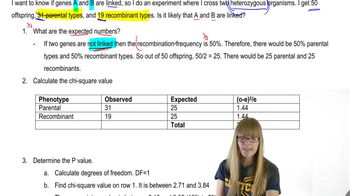
Chi Square and Linkage

Map Units (m.u.)

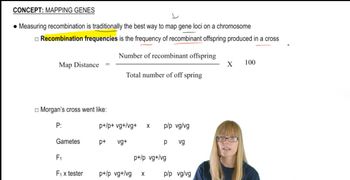
Map units, or centimorgans (cM), are a unit of measurement used in genetics to express the distance between genes on a chromosome. One map unit corresponds to a 1% chance of recombination occurring between two genes during meiosis. In the given question, the distances between the genes for body color, eye color, and bristle form are provided in map units, which are essential for determining the likelihood of genetic linkage among them.
Recommended video:
Guided course
09:09
Mapping Genes

Dominance and Alleles

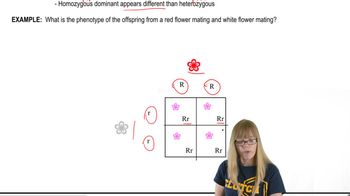
Dominance refers to the relationship between alleles of a gene, where the presence of a dominant allele masks the expression of a recessive allele. In the context of the Drosophila genes mentioned, the wild-type alleles (y⁺, w⁺, f⁺) are dominant over their respective mutant alleles (y, w, f). Understanding dominance is crucial for predicting phenotypic outcomes in genetic crosses, especially when considering how linked genes may influence trait inheritance.
Recommended video:
Guided course
04:37
Variations on Dominance
Related Practice
Textbook Question

Genes E and H are syntenic in an experimental organism with the genotype EH/eh. Assume that during each meiosis, one crossover occurs between these genes. No homologous chromosomes escape crossover, and none undergo double crossover. Are genes E and H genetically linked? Why or why not? What is the proportion of parental gametes produced by meiosis?

530
views
Textbook Question

In tomato plants, purple leaf color is controlled by a dominant allele A, and green leaf by a recessive allele a. At another locus, hairy leaf H is dominant to hairless leaf h. The genes for leaf color and leaf texture are separated by 16 m.u. on chromosome 5. On chromosome 4, a gene controlling leaf shape has two alleles: a dominant allele C that produces cut-leaf shape and a recessive allele c that produces potato-shaped leaves.

The cross of a purple, hairy, cut plant heterozygous at each gene to a green, hairless potato plant produces the following progeny:


Give the genotypes of parental and progeny plants in this experiment.

568
views
Textbook Question

In tomato plants, purple leaf color is controlled by a dominant allele A, and green leaf by a recessive allele a. At another locus, hairy leaf H is dominant to hairless leaf h. The genes for leaf color and leaf texture are separated by 16 m.u. on chromosome 5. On chromosome 4, a gene controlling leaf shape has two alleles: a dominant allele C that produces cut-leaf shape and a recessive allele c that produces potato-shaped leaves.

Fully explain the number and frequency of each phenotype class.

507
views
Textbook Question

In Drosophila, the map positions of genes are given in map units numbering from one end of a chromosome to the other. The X chromosome of Drosophila is 66 m.u. long. The X-linked gene for body color—with two alleles, y⁺ for gray body and y for yellow body—resides at one end of the chromosome at map position 0.0. A nearby locus for eye color, with alleles w⁺ for red eye and w for white eye, is located at map position 1.5. A third X-linked gene, controlling bristle form, with f⁺ for normal bristles and f for forked bristles, is located at map position 56.7. At each locus the wild-type allele is dominant over the mutant allele.


Do you expect any of these gene pair(s) to assort independently? Explain your reasoning.

424
views
Textbook Question

In Drosophila, the map positions of genes are given in map units numbering from one end of a chromosome to the other. The X chromosome of Drosophila is 66 m.u. long. The X-linked gene for body color—with two alleles, y⁺ for gray body and y for yellow body—resides at one end of the chromosome at map position 0.0. A nearby locus for eye color, with alleles w⁺ for red eye and w for white eye, is located at map position 1.5. A third X-linked gene, controlling bristle form, with f⁺ for normal bristles and f for forked bristles, is located at map position 56.7. At each locus the wild-type allele is dominant over the mutant allele.


A wild-type female fruit fly with the genotype y⁺w⁺f/ywf⁺ is crossed to a male fruit fly that has yellow body, white eye, and forked bristles. Predict the frequency of each progeny phenotype class produced by this mating.

544
views
Textbook Question

In Drosophila, the map positions of genes are given in map units numbering from one end of a chromosome to the other. The X chromosome of Drosophila is 66 m.u. long. The X-linked gene for body color—with two alleles, y⁺ for gray body and y for yellow body—resides at one end of the chromosome at map position 0.0. A nearby locus for eye color, with alleles w⁺ for red eye and w for white eye, is located at map position 1.5. A third X-linked gene, controlling bristle form, with f⁺ for normal bristles and f for forked bristles, is located at map position 56.7. At each locus the wild-type allele is dominant over the mutant allele.


Explain how each of the predicted progeny classes is produced.

723
views