
What general effects would you expect the following changes to have on the rate of an enzyme-catalyzed reaction for an enzyme that has its maximum activity at body temperature (about 37°C)?
a. Raising the temperature from 37°C to 70°C
Verified step by step guidance
What general effects would you expect the following changes to have on the rate of an enzyme-catalyzed reaction for an enzyme that has its maximum activity at body temperature (about 37°C)?
a. Raising the temperature from 37°C to 70°C
What general effects would you expect the following changes to have on the rate of an enzyme-catalyzed reaction for an enzyme that has its maximum activity at body temperature (about 37°C)?
c. Adding an organic solvent, such as methanol
What general effects would you expect the following changes to have on the rate of an enzyme-catalyzed reaction for an enzyme that has its maximum activity at body temperature (about 37°C)?
c. Adding an oxidizing agent, such as hydrogen peroxide
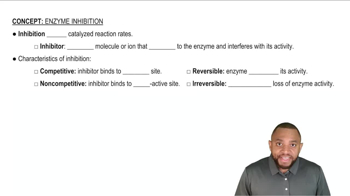
What kind of inhibition (uncompetitive, competitive, or irreversible) is present in each of the following:
a. Penicillin is used to treat certain bacterial infections. Penicillin is effective because it binds to the enzyme glycopeptide transpeptidase and does not dissociate.
What kind of inhibition (uncompetitive, competitive, or irreversible) is present in each of the following:
c. The antibiotic deoxycycline inhibits the bacterial enzyme collagenase, slowing bacterial growth. Deoxycycline does not fit into the active site of collagenase and binds elsewhere on the enzyme.
One mechanism by which lead exerts its poisonous effect on enzymes can be stopped by chelation therapy with EDTA. Describe this type of lead poisoning and explain why it is reversible.