Pearson+ LogoPearson+ Logo
Ch.18 Amino Acids and Proteins
McMurry - Fundamentals of GOB 8th Edition
McMurry8th EditionFundamentals of GOBISBN: 9780134015187Not the one you use?Change textbook
Chapter 18, Problem 23

Examine the α-helix in Figure 18.1 and determine how many backbone C and N atoms are included in the loop between an amide hydrogen atom and the carbonyl oxygen to which it is hydrogen bonded.

Verified step by step guidance
1
Examine the structure of the α-helix in Figure 18.1. The α-helix is a common secondary structure in proteins, stabilized by hydrogen bonds between the backbone amide hydrogen and the carbonyl oxygen of amino acids.
Identify the hydrogen bond in the α-helix. This bond occurs between the amide hydrogen of one amino acid and the carbonyl oxygen of another amino acid located four residues earlier in the sequence.
Count the number of backbone atoms (C and N) in the loop formed by this hydrogen bond. The backbone atoms include the nitrogen (N) of the amide group, the alpha carbon (Cα), and the carbonyl carbon (C=O) of each amino acid.
Trace the loop starting from the amide hydrogen atom, moving through the backbone atoms of the intervening amino acids, and ending at the carbonyl oxygen atom involved in the hydrogen bond.
Add up the total number of backbone C and N atoms in this loop, ensuring you include all the atoms from the starting point (amide hydrogen) to the endpoint (carbonyl oxygen).

Verified video answer for a similar problem:

This video solution was recommended by our tutors as helpful for the problem above.
Was this helpful?

Key Concepts

Here are the essential concepts you must grasp in order to answer the question correctly.

α-helix Structure

The α-helix is a common secondary structure in proteins, characterized by a right-handed coil where each turn of the helix contains about 3.6 amino acids. The backbone of the helix is stabilized by hydrogen bonds between the carbonyl oxygen of one amino acid and the amide hydrogen of another, typically four residues earlier in the sequence. Understanding this structure is crucial for analyzing the spatial arrangement of atoms within the helix.
Recommended video:
Guided course
3:27
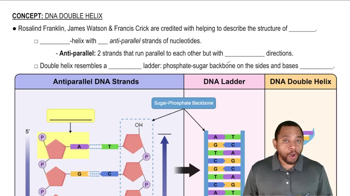
DNA Double Helix Concept 1

Backbone Atoms

In protein structures, the backbone refers to the main chain of the polypeptide, consisting of repeating units of nitrogen (N), carbon (C), and carbonyl (C=O) groups. The backbone atoms are essential for determining the overall shape and stability of the protein. In the context of the α-helix, identifying the specific backbone C and N atoms involved in hydrogen bonding is key to understanding the loop structure.
Recommended video:
Guided course
05:22
Atomic Theory

Hydrogen Bonding

Hydrogen bonding is a type of attractive interaction that occurs between a hydrogen atom covalently bonded to an electronegative atom (like nitrogen or oxygen) and another electronegative atom. In the α-helix, these bonds are critical for maintaining the helical structure, as they provide stability and influence the spatial arrangement of the backbone atoms. Recognizing how these bonds form between amide hydrogens and carbonyl oxygens is essential for analyzing the loop in the helix.
Recommended video:
Guided course
1:22
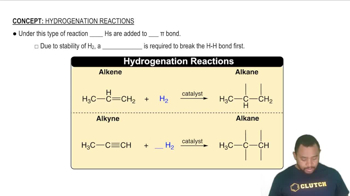
Hydrogenation Reactions Concept 1