Pearson+ LogoPearson+ Logo
Ch.18 Amino Acids and Proteins
McMurry - Fundamentals of GOB 8th Edition
McMurry8th EditionFundamentals of GOBISBN: 9780134015187Not the one you use?Change textbook
Chapter 18, Problem 20b

How many amino acid units do these atoms come from? Why are these units planar?

Verified step by step guidance
1
Understand the context: Amino acids are the building blocks of proteins, and they are linked together by peptide bonds to form polypeptides. The question is asking about the number of amino acid units contributing to a specific structure and why certain parts of this structure are planar.
Identify the atoms in question: Determine which atoms are being referred to in the problem. Typically, this involves the atoms in the peptide bond (C, O, N, and H) and the alpha carbon (Cα) of the amino acids.
Explain the planarity of the peptide bond: The peptide bond is planar because it has partial double-bond character due to resonance. The lone pair of electrons on the nitrogen delocalizes into the carbonyl group, creating a resonance structure. This restricts rotation around the bond and forces the atoms involved in the peptide bond (C, O, N, and H) to lie in the same plane.
Count the amino acid units: Each peptide bond connects two amino acids. If the structure in question contains one peptide bond, it comes from two amino acid units. If there are multiple peptide bonds, count the number of bonds to determine the number of amino acid units.
Summarize: The planarity of the peptide bond is due to resonance, which restricts rotation and forces the involved atoms into a planar configuration. The number of amino acid units depends on the number of peptide bonds present in the structure.

Verified video answer for a similar problem:

This video solution was recommended by our tutors as helpful for the problem above.
Was this helpful?

Key Concepts

Here are the essential concepts you must grasp in order to answer the question correctly.

Amino Acids

Amino acids are organic compounds that serve as the building blocks of proteins. Each amino acid consists of a central carbon atom, an amino group, a carboxyl group, a hydrogen atom, and a variable side chain (R group). The sequence and composition of amino acids in a protein determine its structure and function. In the context of the question, understanding how many amino acid units are formed from specific atoms requires knowledge of the molecular structure of amino acids.
Recommended video:
Guided course
3:03
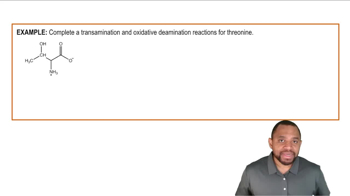
Amino Acid Catabolism: Amino Group Example 2

Planarity of Amino Acids

The planarity of amino acid units arises from the peptide bond formation between the amino group of one amino acid and the carboxyl group of another. This bond creates a rigid structure due to the partial double bond character, which restricts rotation around the bond. As a result, the atoms involved in the peptide bond and the adjacent carbon atoms lie in the same plane, contributing to the overall planar nature of the polypeptide backbone.
Recommended video:
Guided course
3:03
Amino Acid Catabolism: Amino Group Example 2

Peptide Bonds

Peptide bonds are covalent bonds that link amino acids together in a protein chain. Formed through a dehydration synthesis reaction, a peptide bond occurs when the carboxyl group of one amino acid reacts with the amino group of another, releasing a molecule of water. This bond is crucial for protein structure, as it not only connects amino acids but also influences the overall conformation and stability of the protein due to its planar nature.
Recommended video:
Guided course
1:24
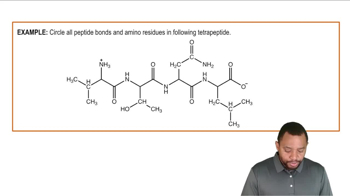
Peptides Example 1