Pearson+ LogoPearson+ Logo
Ch.18 Amino Acids and Proteins
McMurry - Fundamentals of GOB 8th Edition
McMurry8th EditionFundamentals of GOBISBN: 9780134015187Not the one you use?Change textbook
Chapter 18, Problem 20a

What atoms are present in a planar unit in a protein chain?

Verified step by step guidance
1
Understand that a planar unit in a protein chain refers to the peptide bond, which is the bond formed between two amino acids during protein synthesis.
Recall that a peptide bond forms when the carboxyl group (-COOH) of one amino acid reacts with the amino group (-NH2) of another amino acid, releasing a molecule of water (H2O) in a condensation reaction.
Recognize that the atoms involved in the planar unit are part of the amide group, which includes the carbon atom from the carbonyl group (C=O), the nitrogen atom from the amino group (N-H), and the hydrogen atom attached to the nitrogen.
Note that the peptide bond and the atoms directly involved in it (C, O, N, H) lie in the same plane due to resonance stabilization, which gives the bond partial double-bond character and restricts rotation.
Conclude that the planar unit in a protein chain consists of the following atoms: one carbon (C), one oxygen (O), one nitrogen (N), and one hydrogen (H), along with the alpha carbon (Cα) atoms of the adjacent amino acids connected to the peptide bond.

Verified video answer for a similar problem:

This video solution was recommended by our tutors as helpful for the problem above.
Was this helpful?

Key Concepts

Here are the essential concepts you must grasp in order to answer the question correctly.

Amino Acids

Amino acids are the building blocks of proteins, consisting of a central carbon atom, an amino group, a carboxyl group, a hydrogen atom, and a variable R group that determines the specific properties of each amino acid. In a protein chain, amino acids are linked by peptide bonds, forming a linear sequence that ultimately folds into a functional three-dimensional structure.
Recommended video:
Guided course
3:03
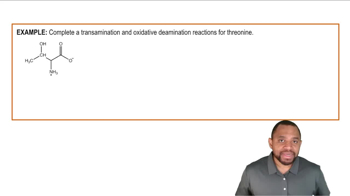
Amino Acid Catabolism: Amino Group Example 2

Peptide Bonds

Peptide bonds are covalent bonds that link amino acids together in a protein chain. They form through a dehydration reaction between the carboxyl group of one amino acid and the amino group of another, resulting in the release of a water molecule. This bond is crucial for maintaining the primary structure of proteins, which is essential for their function.
Recommended video:
Guided course
1:24
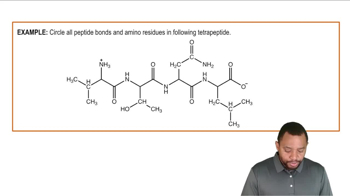
Peptides Example 1

Planar Structure

The planar structure of a protein chain refers to the geometric arrangement of atoms around the peptide bond, which restricts rotation and creates a flat, rigid configuration. This planarity is due to the partial double-bond character of the peptide bond, influencing the overall conformation of the protein and its interactions with other molecules.
Recommended video:
Guided course
1:01
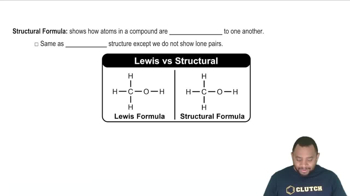
Structural Formula Concept 2