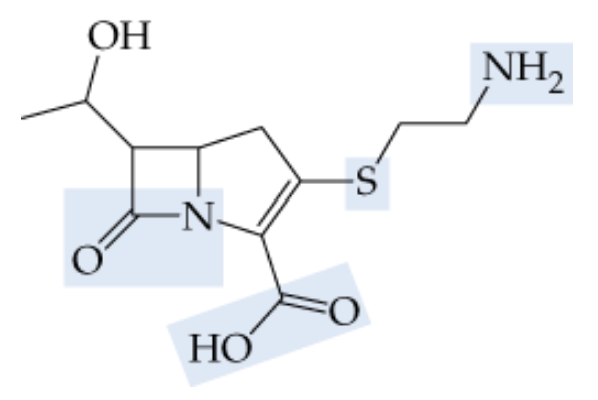
Identify the indicated functional groups in the following molecules: b. Thienamycin, an antibiotic
Verified step by step guidance
1
Step 1: Understand the problem. The task is to identify the functional groups present in the molecule Thienamycin, an antibiotic. Functional groups are specific groups of atoms within molecules that are responsible for the characteristic chemical reactions of those molecules.
Step 2: Analyze the structure of Thienamycin. Look at the molecular structure provided in the image. Identify distinct regions of the molecule where functional groups are present. Common functional groups include hydroxyl (-OH), amine (-NH2), carboxylic acid (-COOH), ketone (C=O), and others.
Step 3: Identify the heterocyclic ring. Thienamycin contains a sulfur-containing heterocyclic ring, which is a thiophene derivative. This is a key structural feature of the molecule.
Step 4: Look for other functional groups. Examine the molecule for additional functional groups such as an amine group (-NH2), which is common in antibiotics, or a carboxylic acid group (-COOH), which may contribute to the molecule's acidity.
Step 5: Summarize the identified functional groups. Based on the analysis, list all the functional groups present in Thienamycin, ensuring you describe their locations within the molecule (e.g., 'primary amine attached to...').
Verified video answer for a similar problem:
This video solution was recommended by our tutors as helpful for the problem above
Play a video:
Was this helpful?
Key Concepts
Here are the essential concepts you must grasp in order to answer the question correctly.
Functional Groups
Functional groups are specific groups of atoms within molecules that are responsible for the characteristic chemical reactions of those molecules. They determine the properties and reactivity of organic compounds. Common functional groups include hydroxyl (-OH), carboxyl (-COOH), and amine (-NH2), each influencing the behavior of the molecule in biological systems.
Thienamycin is a beta-lactam antibiotic that contains a thiazolidine ring and a beta-lactam ring, which are crucial for its antibacterial activity. Understanding its structure helps in identifying the functional groups present, such as the amide and thiazole groups, which contribute to its mechanism of action against bacterial cell walls.
Antibiotics like thienamycin work by inhibiting the synthesis of bacterial cell walls, leading to cell lysis and death. The presence of specific functional groups in thienamycin allows it to bind to penicillin-binding proteins (PBPs), disrupting the normal function of these proteins and effectively combating bacterial infections.