Pearson+ LogoPearson+ Logo
Ch.12 Introduction to Organic Chemistry: Alkanes
McMurry - Fundamentals of GOB 8th Edition
McMurry8th EditionFundamentals of GOBISBN: 9780134015187Not the one you use?Change textbook
Chapter 12, Problem 59

Draw the structural formulas and name all cyclic isomers with the formula C5H10.

Verified step by step guidance
1
Step 1: Understand the problem. The molecular formula C5H10 indicates a hydrocarbon with 5 carbon atoms and 10 hydrogen atoms. Since the formula follows the general formula for cycloalkanes (CnH2n), we are tasked with identifying all possible cyclic isomers of this compound.
Step 2: Begin by drawing the simplest cyclic structure, cyclopentane. Cyclopentane is a five-membered ring with no substituents. Its structural formula is a pentagon, where each vertex represents a carbon atom, and each carbon is bonded to two hydrogens.
Step 3: Next, consider smaller rings with substituents. Draw cyclobutane (a four-membered ring) with one methyl group (-CH3) attached to one of the carbons. This is called methylcyclobutane. Ensure the methyl group is clearly shown in the structural formula.
Step 4: Continue by drawing cyclopropane (a three-membered ring) with two substituents. For example, draw 1,1-dimethylcyclopropane (two methyl groups attached to the same carbon) and 1,2-dimethylcyclopropane (two methyl groups attached to adjacent carbons). These are distinct isomers.
Step 5: Verify that all possible cyclic isomers have been considered. Ensure that no additional unique structures can be formed by rearranging the carbon atoms or substituents. Name each isomer systematically using IUPAC nomenclature to confirm their uniqueness.

Verified video answer for a similar problem:

This video solution was recommended by our tutors as helpful for the problem above.
Video duration:
5m
Was this helpful?

Key Concepts

Here are the essential concepts you must grasp in order to answer the question correctly.

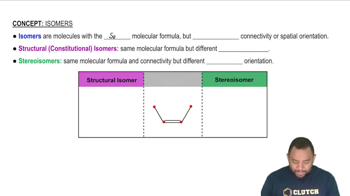
Cyclic Isomers

Cyclic isomers are compounds that have the same molecular formula but differ in the arrangement of atoms in a ring structure. For C5H10, cyclic isomers can include various configurations such as cyclopentane and methylcyclobutane. Understanding the concept of cyclic structures is essential for identifying and drawing their structural formulas.
Recommended video:
Guided course
2:16
Isomers Concept 1

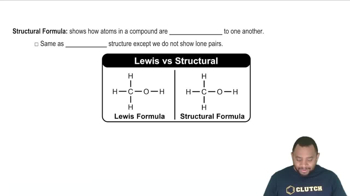
Structural Formula

A structural formula represents the arrangement of atoms within a molecule, showing how they are bonded together. It provides insight into the connectivity of atoms, which is crucial for distinguishing between different isomers. For C5H10, drawing the structural formulas helps visualize the various cyclic isomers and their unique characteristics.
Recommended video:
Guided course
1:01
Structural Formula Concept 2

Isomerism

Isomerism refers to the phenomenon where compounds share the same molecular formula but have different structural or spatial arrangements. In the case of C5H10, isomerism can lead to various cyclic and acyclic forms. Recognizing the types of isomerism, such as structural and stereoisomerism, is vital for comprehending the diversity of compounds that can be formed from a given formula.
Recommended video:
Guided course
1:26
Glycolysis Concept 5