Pearson+ LogoPearson+ Logo
Ch.12 Introduction to Organic Chemistry: Alkanes
McMurry - Fundamentals of GOB 8th Edition
McMurry8th EditionFundamentals of GOBISBN: 9780134015187Not the one you use?Change textbook
Chapter 12, Problem 60

Propane, commonly known as liquid petroleum (LP) gas, burns in air to yield CO2 and H2O. Write a balanced equation for the reaction.

Verified step by step guidance
1
Identify the chemical formula for propane, which is C₃H₈, and recognize that it reacts with oxygen (O₂) in a combustion reaction to produce carbon dioxide (CO₂) and water (H₂O).
Write the unbalanced chemical equation for the combustion of propane: C₃H₈ + O₂ → CO₂ + H₂O.
Balance the carbon (C) atoms first. Since there are 3 carbon atoms in propane (C₃H₈), place a coefficient of 3 in front of CO₂: C₃H₈ + O₂ → 3CO₂ + H₂O.
Next, balance the hydrogen (H) atoms. Propane has 8 hydrogen atoms, so place a coefficient of 4 in front of H₂O to account for all the hydrogen atoms: C₃H₈ + O₂ → 3CO₂ + 4H₂O.
Finally, balance the oxygen (O) atoms. There are 10 oxygen atoms on the product side (3 from CO₂ and 4 from H₂O), so place a coefficient of 5 in front of O₂ on the reactant side: C₃H₈ + 5O₂ → 3CO₂ + 4H₂O.

Verified video answer for a similar problem:

This video solution was recommended by our tutors as helpful for the problem above.
Was this helpful?

Key Concepts

Here are the essential concepts you must grasp in order to answer the question correctly.

Combustion Reaction

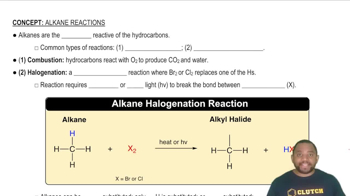
A combustion reaction is a chemical process in which a substance reacts rapidly with oxygen, producing heat and light. In the case of propane, the reaction involves the hydrocarbon reacting with oxygen to produce carbon dioxide and water. This type of reaction is essential in understanding how fuels like propane release energy.
Recommended video:
Guided course
2:25
Common Types of Alkane Reactions Concept 1

Balancing Chemical Equations

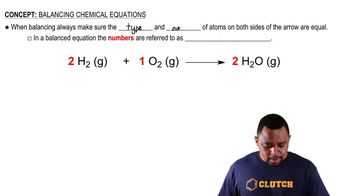
Balancing chemical equations is the process of ensuring that the number of atoms for each element is the same on both sides of the equation. This is crucial for obeying the law of conservation of mass, which states that matter cannot be created or destroyed in a chemical reaction. A balanced equation accurately represents the stoichiometry of the reaction.
Recommended video:
Guided course
01:32
Balancing Chemical Equations (Simplified) Concept 1

Stoichiometry

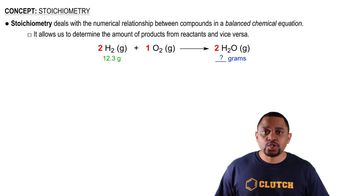
Stoichiometry is the study of the quantitative relationships between the reactants and products in a chemical reaction. It allows chemists to predict the amounts of substances consumed and produced in a reaction. Understanding stoichiometry is vital for writing balanced equations and for practical applications in chemistry, such as calculating yields.
Recommended video:
Guided course
01:16
Stoichiometry