


Pearson+ LogoPearson+ Logo
Ch.2 Atoms and the Periodic Table
McMurry - Fundamentals of GOB 8th Edition
McMurry8th EditionFundamentals of GOBISBN: 9780134015187Not the one you use?Change textbook
Chapter 2, Problem 90

What is wrong with the following electron configurations?
a. Ni 1s2 2s2 2p6 3s2 3p6 3d10
b. N 1s2 2p5
c. Electron configuration for silicon with notation and an empty box for additional configurations.
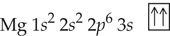
d. Electron configuration for magnesium with notation and arrows indicating electron spins.

Verified step by step guidance
1
Step 1: Recall the Aufbau principle, which states that electrons fill orbitals starting from the lowest energy level to the highest. This principle helps us determine the correct order of electron configurations.
Step 2: Analyze configuration (a): Ni 1s^2 2s^2 2p^6 3s^2 3p^6 3d^10. Nickel (Ni) has an atomic number of 28, meaning it should have 28 electrons. However, this configuration only accounts for 28 electrons but skips the 4s orbital, which should be filled before the 3d orbital. The correct configuration should include 4s^2 before 3d^8.
Step 3: Analyze configuration (b): N 1s^2 2p^5. Nitrogen (N) has an atomic number of 7, meaning it should have 7 electrons. However, this configuration skips the 2s orbital, which should be filled before the 2p orbital. The correct configuration should be 1s^2 2s^2 2p^3.
Step 4: Analyze configuration (c): Si 1s^2 2s^2 2p. Silicon (Si) has an atomic number of 14, meaning it should have 14 electrons. This configuration is incomplete because it does not fully fill the 2p orbital (which can hold up to 6 electrons) and does not include the 3s and 3p orbitals. The correct configuration should be 1s^2 2s^2 2p^6 3s^2 3p^2.
Step 5: Analyze configuration (d): Mg 1s^2 2s^2 2p^6 3s. Magnesium (Mg) has an atomic number of 12, meaning it should have 12 electrons. This configuration is incomplete because the 3s orbital should be fully filled with 2 electrons. The correct configuration should be 1s^2 2s^2 2p^6 3s^2.

Verified video answer for a similar problem:

This video solution was recommended by our tutors as helpful for the problem above.
Video duration:
7m
Was this helpful?

Key Concepts

Here are the essential concepts you must grasp in order to answer the question correctly.

Electron Configuration

Electron configuration describes the distribution of electrons in an atom's orbitals. It follows specific rules, such as the Aufbau principle, which states that electrons fill lower-energy orbitals before higher-energy ones. Understanding the correct order of filling and the maximum number of electrons each orbital can hold is essential for identifying errors in configurations.
Recommended video:
Guided course
01:08
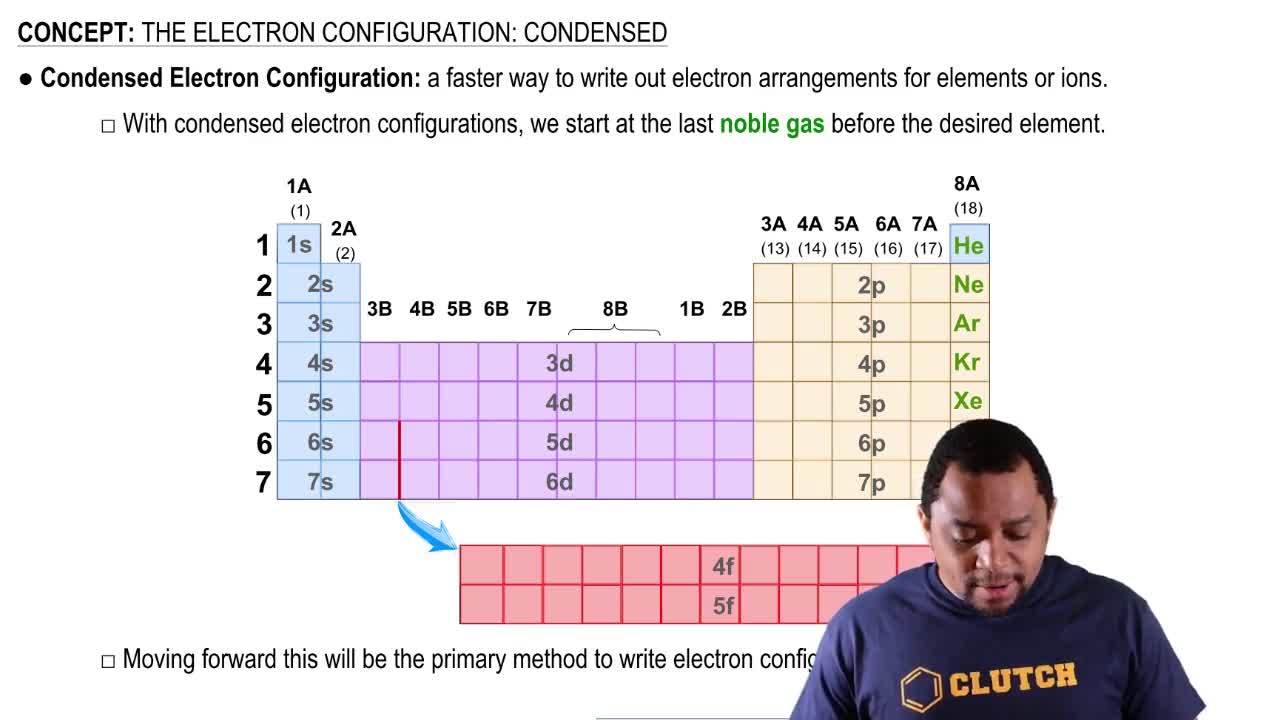
The Electron Configuration: Condensed

Pauli Exclusion Principle

The Pauli Exclusion Principle states that no two electrons in an atom can have the same set of four quantum numbers. This principle implies that an orbital can hold a maximum of two electrons, which must have opposite spins. Recognizing this principle helps in identifying incorrect electron configurations where orbitals are improperly filled.

Hund's Rule

Hund's Rule states that electrons will occupy degenerate orbitals (orbitals of the same energy) singly before pairing up. This means that for orbitals like p, d, and f, each orbital should receive one electron before any orbital receives a second. Understanding this rule is crucial for determining the correct arrangement of electrons in multi-electron atoms.
Recommended video:
Guided course
00:28
Solubility Rules