Pearson+ LogoPearson+ Logo
Ch.15 Aldehydes and Ketones
McMurry - Fundamentals of GOB 8th Edition
McMurry8th EditionFundamentals of GOBISBN: 9780134015187Not the one you use?Change textbook
Chapter 15, Problem 26a

Draw a structure for a compound that meets each of the following descriptions:
a. A 6-carbon cyclic ketone with a methyl group on the beta carbon

Verified step by step guidance
1
Step 1: Understand the problem. A 6-carbon cyclic ketone means the compound has a ring structure with 6 carbons, and one of the carbons in the ring is part of a ketone functional group (C=O).
Step 2: Identify the beta carbon. In organic chemistry, the beta carbon is the second carbon away from the functional group. For a ketone, the carbonyl carbon (C=O) is the reference point, and the beta carbon is two carbons away from it.
Step 3: Add a methyl group to the beta carbon. A methyl group is a -CH₃ group. Attach this group to one of the beta carbons in the ring structure.
Step 4: Ensure the structure satisfies all requirements. Verify that the compound has a total of 6 carbons in the ring, includes a ketone functional group, and has a methyl group on the beta carbon.
Step 5: Draw the structure. Represent the 6-carbon cyclic ketone with the ketone group (C=O) and the methyl group (-CH₃) attached to the beta carbon. Use proper bond-line notation to depict the structure clearly.

Verified video answer for a similar problem:

This video solution was recommended by our tutors as helpful for the problem above.
Was this helpful?

Key Concepts

Here are the essential concepts you must grasp in order to answer the question correctly.

Cyclic Ketones

Cyclic ketones are organic compounds that contain a carbonyl group (C=O) within a ring structure. In these compounds, the carbonyl carbon is bonded to two other carbon atoms, forming a closed loop. The properties and reactivity of cyclic ketones can differ significantly from their acyclic counterparts due to the strain and sterics introduced by the ring structure.
Recommended video:
Guided course
2:55
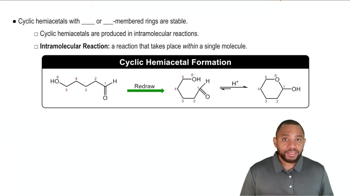
Cyclic Hemiacetals Concept 2

Beta Carbon

In organic chemistry, the beta carbon refers to the second carbon atom in a carbon chain or ring, relative to a functional group, such as a carbonyl. In the context of cyclic ketones, identifying the beta carbon is crucial for substituent placement, as it determines where additional groups, like a methyl group, can be attached while maintaining the compound's structural integrity.
Recommended video:
Guided course
01:26
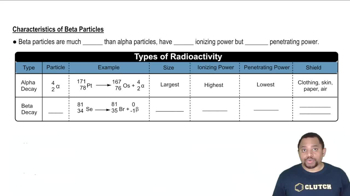
Beta Decay Example 1

Structural Representation

Structural representation in chemistry involves depicting the arrangement of atoms within a molecule, including bonds and functional groups. This can be done through various methods, such as Lewis structures, skeletal formulas, or 3D models. Accurate structural representation is essential for understanding the compound's properties, reactivity, and potential interactions with other molecules.
Recommended video:
Guided course
2:08
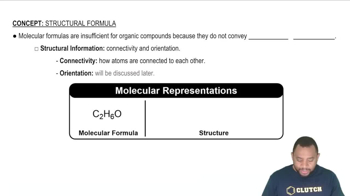
Molecular Representations Concept 1