
Textbook Question
Draw a structure for a compound that meets each of the following descriptions:
b. An aldehyde with four carbons
656
views
1
rank

 Verified step by step guidance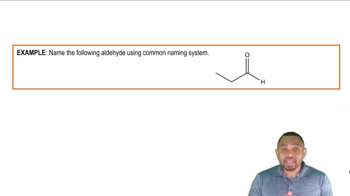
 0:34
0:34
 1:29
1:29 1:19
1:19Draw a structure for a compound that meets each of the following descriptions:
b. An aldehyde with four carbons
The carbonyl group can be reduced by addition of a hydride ion (H–) and (H+) a proton. Removal of H– and H+ from an alcohol results in a carbonyl group.
a. To which atom of the carbonyl is the hydride ion added and why?
The carbonyl group can be reduced by addition of a hydride ion (H–) and (H+) a proton. Removal of H– and H+ from an alcohol results in a carbonyl group.
b. In the reaction, indicate which direction represents reduction and which represents oxidation.
For each compound shown next, determine whether it is a hemiacetal, a hemiketal, an acetal, or a ketal.
a.
b.
c.
d.
Glucose is the major sugar in mammalian blood. We often see it represented as either the "free aldehyde" or the cyclic hemiacetal forms shown here. Of the two forms of glucose, the cyclic hemiacetal is the preferred form found in blood. Can you suggest two reasons why?
Draw a structure for a compound that meets each of the following descriptions:
a. A 6-carbon cyclic ketone with a methyl group on the beta carbon