Back

Chemical Equilibrium quiz

Control buttons has been changed to "navigation" mode.
1/15
  • What does it mean when a chemical reaction goes to completion?

    It means all reactants are fully converted into products, leaving no reactant behind.
  • Do most chemical reactions go to completion?

    No, most chemical reactions do not go to completion; some reactant always remains.
  • What is chemical equilibrium?

    Chemical equilibrium is the state where the concentrations of reactants and products become constant over time.
  • Are reactions at equilibrium still occurring at the molecular level?

    Yes, reactions continue in both forward and reverse directions, but their rates are equal so concentrations remain constant.
  • What do double arrows in a chemical equation indicate?

    Double arrows indicate that the reaction is reversible and can proceed in both forward and reverse directions.
  • What does the rate constant k1 represent?

    k1 represents the rate constant for the forward direction of a reversible reaction.
  • What does the rate constant k-1 represent?

    k-1 represents the rate constant for the reverse direction of a reversible reaction.
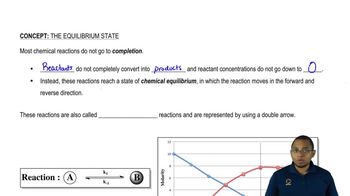
  • How can you tell from a graph that a reaction has reached equilibrium?

    When the concentrations of both reactants and products plateau and remain constant, equilibrium has been reached.
  • What happens to the concentration of reactants as a reaction approaches equilibrium?

    The concentration of reactants decreases until it reaches a constant value at equilibrium.
  • What happens to the concentration of products as a reaction approaches equilibrium?

    The concentration of products increases until it reaches a constant value at equilibrium.
  • Why do the concentrations of reactants and products remain constant at equilibrium?

    Because the rate of the forward reaction equals the rate of the reverse reaction, so their amounts do not change.
  • Is it possible for a reaction to have a large amount of reactant left at equilibrium?

    Yes, the amount of reactant left at equilibrium can be large or small depending on the specific reaction.
  • What is meant by a reversible reaction?

    A reversible reaction is one that can proceed in both the forward and reverse directions.
  • At what point in time is equilibrium reached according to the graph discussed?

    Equilibrium is reached at the point where the concentrations of reactants and products plateau, such as at the 5-minute mark in the example.
  • What maintains the constant levels of reactants and products at equilibrium?

    The forward and reverse reactions occur at equal rates, so any loss of reactant is balanced by the reverse formation from products.