Back

Cyclic Structures of Monosaccharides definitions

Control buttons has been changed to "navigation" mode.
1/13
  • Monosaccharide

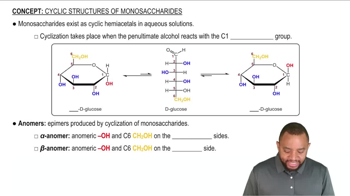
    A simple sugar molecule that can form cyclic structures in water through internal reactions.
  • Cyclic Hemiacetal

    A ring structure formed when an alcohol group reacts with an aldehyde group within the same sugar molecule.
  • Aqueous Solution

    A water-based environment where monosaccharides readily convert to their ring forms.
  • Penultimate Alcohol

    The second-to-last hydroxyl group in a sugar chain, crucial for initiating ring formation.
  • Aldehyde Group

    A functional group at the end of a sugar chain that reacts with an alcohol to form a ring.
  • Acyclic Form

    The open-chain structure of a monosaccharide before it cyclizes in solution.
  • D-Glucose

    A common monosaccharide that forms cyclic structures, serving as a model for ring formation.
  • Anomeric Carbon

    The carbon atom in a sugar ring where the configuration determines alpha or beta forms.
  • Alpha Anomer

    A ring form where the OH group at the anomeric carbon is opposite the CH2OH group.
  • Beta Anomer

    A ring form where the OH group at the anomeric carbon is on the same side as the CH2OH group.
  • Epimer

    A stereoisomer differing from another only at one specific chiral center.
  • Chiral Center

    A carbon atom bonded to four different groups, leading to stereoisomerism in sugars.
  • Hemiacetal Carbon

    A carbon atom in a sugar ring bonded to both an OH and an OR group, formed during cyclization.