Back

Cyclic Structures of Monosaccharides quiz

Control buttons has been changed to "navigation" mode.
1/15
  • What form do monosaccharides predominantly exist in when dissolved in water?

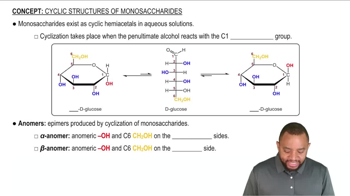
    Monosaccharides exist as cyclic hemiacetals in aqueous solutions.
  • What triggers the cyclization of a monosaccharide like D-glucose?

    Cyclization occurs when the penultimate alcohol group reacts with the C1 aldehyde group.
  • Which alcohol group is involved in the cyclization of D-glucose?

    The penultimate alcohol group is involved in the cyclization process.
  • What is the acyclic form of D-glucose converted into during cyclization?

    It is converted into a cyclic hemiacetal form.
  • What are anomers in the context of monosaccharide cyclization?

    Anomers are epimers produced by cyclization, differing only at the anomeric carbon.
  • At which carbon do the alpha and beta forms of glucose differ?

    They differ at the anomeric carbon, which is carbon number 1.
  • How are alpha and beta anomers of glucose distinguished?

    They are distinguished by the orientation of the OH group at the anomeric carbon.
  • What is the configuration of the OH and CH2OH groups in alpha-D-glucose?

    In alpha-D-glucose, the OH and CH2OH groups are on opposite sides of the ring.
  • What is the configuration of the OH and CH2OH groups in beta-D-glucose?

    In beta-D-glucose, the OH and CH2OH groups are on the same side of the ring.
  • What is another name for the anomeric carbon in glucose?

    The anomeric carbon is also called the hemiacetal carbon.
  • What happens to the OH group at the anomeric carbon to form alpha or beta glucose?

    The OH group can orient down for alpha or up for beta glucose.
  • What is an epimer in carbohydrate chemistry?

    An epimer is a molecule that differs from another only at one chiral center.
  • What is the dominant form of glucose in aqueous solution?

    The dominant forms are the cyclic hemiacetals, either alpha or beta rings.
  • What is the significance of the orientation of groups around the anomeric carbon?

    It determines whether the glucose is in the alpha or beta form.
  • What structural change occurs when glucose transitions from its acyclic to cyclic form?

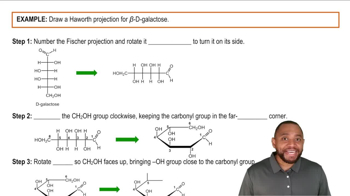
    The molecule coils up, forming a ring structure as a cyclic hemiacetal.