Back

Dipole Moment (Simplified) definitions

Control buttons has been changed to "navigation" mode.
1/14
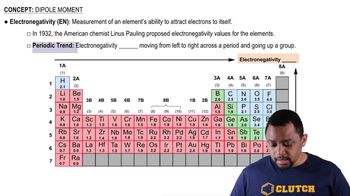
  • Electronegativity

    Measurement of an element's ability to attract electrons, increasing across a period and up a group, with fluorine as the highest.
  • Linus Pauling

    American chemist who proposed the scale for measuring how strongly elements attract electrons in bonds.
  • Periodic Trend

    Pattern observed in the periodic table where certain properties, like electron attraction, change predictably across periods and groups.
  • Fluorine

    Element with the highest tendency to attract electrons, serving as a reference point for comparing other elements' electron attraction.
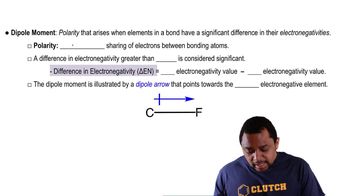
  • Dipole Moment

    Polarity in a bond resulting from significant differences in electron attraction between bonded atoms, indicated by an arrow.
  • Polarity

    Unequal sharing of electrons in a bond, leading to regions of partial positive and negative charge.
  • Dipole Arrow

    Symbol used to show the direction of electron shift in a polar bond, always pointing toward the more electron-attracting atom.
  • Partial Charge

    Slight positive or negative character on atoms in a polar bond due to unequal electron sharing.
  • Pure Covalent Bond

    Bond where two atoms share electrons equally, resulting in no charge separation or polarity.
  • Nonpolar Covalent Bond

    Bond with a small difference in electron attraction, causing nearly equal sharing of electrons.
  • Polar Covalent Bond

    Bond with a moderate difference in electron attraction, resulting in partial charges and a dipole moment.
  • Ionic Bond

    Bond formed when one atom fully transfers electrons to another, creating ions with full positive and negative charges.
  • Cation

    Positively charged ion formed when an atom loses electrons, often seen in bonds with large electron attraction differences.
  • Anion

    Negatively charged ion formed when an atom gains electrons, typically in highly polar or ionic bonds.