GOB Chemistry
My Course
Learn
Exam Prep
AI Tutor
Study Guides
Textbook Solutions
Flashcards
Explore
Try the app
My Course
Learn
Exam Prep
AI Tutor
Study Guides
Textbook Solutions
Flashcards
Explore
Try the app
Back
Dipole Moment (Simplified) quiz
You can tap to flip the card.
Who proposed the concept of electronegativity and in what year?
You can tap to flip the card.
👆
Who proposed the concept of electronegativity and in what year?
Linus Pauling proposed electronegativity in 1932.
Track progress
Control buttons has been changed to "navigation" mode.
1/15
Related flashcards
Related practice
Recommended videos
Dipole Moment (Simplified) definitions
Dipole Moment (Simplified)
14 Terms
Dipole Moment (Simplified)
4. Molecular Compounds
7 problems
Topic

Jules
Molecular Polarity (Simplified)
4. Molecular Compounds
5 problems
Topic
Jules
4. Molecular Compounds - Part 1 of 2
8 topics
13 problems
Chapter
Jules
4. Molecular Compounds - Part 2 of 2
8 topics
12 problems
Chapter
Jules
Guided course
01:07
Dipole Moment (Simplified) Example 3
7912
views
50
rank
Guided course
01:51
Dipole Moment (Simplified) Concept 1
3466
views
14
rank
Guided course
01:25
Dipole Moment (Simplified) Concept 2
10075
views
83
rank
Terms in this set (15)
Hide definitions
Who proposed the concept of electronegativity and in what year?
Linus Pauling proposed electronegativity in 1932.
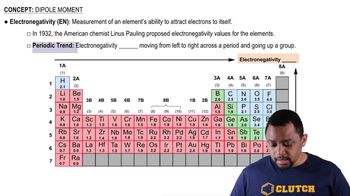
How does electronegativity change across the periodic table?
Electronegativity increases from left to right across a period and from bottom to top within a group.
Which element is the most electronegative and how can you remember it?
Fluorine is the most electronegative element; you can remember this by associating it with a perfect 4.0 GPA.
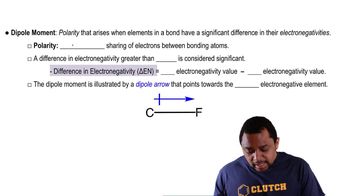
What is a dipole moment in a chemical bond?
A dipole moment is the polarity that arises when two bonded atoms have a significant difference in their electronegativities.
At what difference in electronegativity does a bond become significantly polar?
A difference in electronegativity greater than 0.4 is considered significant and leads to polarity.
In a polar bond, towards which atom does the dipole arrow point?
The dipole arrow points towards the more electronegative atom.
What partial charges do the atoms in a polar covalent bond acquire?
The more electronegative atom becomes partially negative (δ-), and the less electronegative atom becomes partially positive (δ+).
How do you calculate the difference in electronegativity between two atoms?
Subtract the lower electronegativity value from the higher one.
What type of bond is formed when the difference in electronegativity is zero?
A pure covalent bond is formed, where electrons are shared equally.
What is the range of electronegativity difference for a nonpolar covalent bond?
A nonpolar covalent bond has a difference between 0.1 and 0.4.
What is the range of electronegativity difference for a polar covalent bond?
A polar covalent bond has a difference between 0.5 and 1.7.
What type of bond is formed when the difference in electronegativity is greater than 1.7?
An ionic bond is formed, where one atom fully transfers electrons to another.
How do the charges differ between polar covalent and ionic bonds?
Polar covalent bonds have partial charges, while ionic bonds have full positive and negative charges.
What happens to the electron cloud in a nonpolar covalent bond?
The electron cloud is shared equally between the atoms, resulting in equal electron distribution.
How does the magnitude of the dipole arrow relate to the difference in electronegativity?
The greater the difference in electronegativity, the larger the dipole arrow and the greater the bond's polarity.