Back

Freezing Point Depression definitions

Control buttons has been changed to "navigation" mode.
1/14
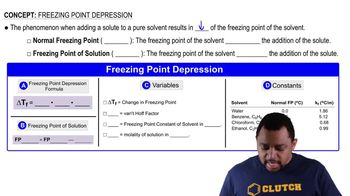
  • Freezing Point Depression

    A phenomenon where adding a solute to a pure solvent lowers the temperature at which the solvent solidifies.
  • Normal Freezing Point

    The temperature at which a pure solvent transitions to a solid before any solute is introduced.
  • Freezing Point of Solution

    The temperature at which a solvent containing dissolved solute solidifies, always lower than the pure solvent.
  • Δtf

    A symbol representing the numerical decrease in freezing point when a solute is added to a solvent.
  • Van't Hoff Factor

    A value indicating the number of particles a solute produces in solution, affecting colligative properties.
  • Freezing Point Constant

    A unique value for each solvent that quantifies how much its freezing point drops per unit molality of solute.
  • Molality

    A concentration unit defined as moles of solute per kilogram of solvent, used in colligative property calculations.
  • Solute

    A substance dissolved in a solvent, causing changes in physical properties like freezing point.
  • Solvent

    The component in which a solute is dissolved, forming a solution and determining the system's freezing point.
  • Solution

    A homogeneous mixture formed when a solute is dissolved in a solvent, exhibiting altered freezing behavior.
  • Water

    A common solvent with a well-known freezing point and freezing point constant, often used in examples.
  • Benzene

    An organic solvent with its own characteristic freezing point and freezing point constant.
  • Chloroform

    A solvent with a unique freezing point and freezing point constant, referenced in colligative property studies.
  • Ethanol

    A widely used solvent with specific freezing point and freezing point constant values.