Back

Molecular Equations definitions

Control buttons has been changed to "navigation" mode.
1/13
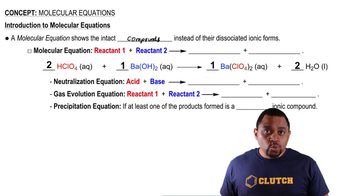
  • Molecular Equation

    Represents chemical reactions with compounds shown intact, not as separated ions, emphasizing the overall transformation.
  • Aqueous Reactant

    A substance dissolved in water that participates in a chemical reaction, often indicated by the (aq) symbol.
  • Product

    A substance formed as a result of a chemical reaction, appearing on the right side of a chemical equation.
  • Neutralization Equation

    A reaction type where an acid and a base in aqueous solution combine to yield water and an ionic salt.
  • Ionic Compound

    A chemical species formed from the electrostatic attraction between oppositely charged ions, often soluble or forming solids.
  • Water

    A common product in acid-base reactions, typically formed when hydrogen ions combine with hydroxide ions.
  • Gas Evolution Equation

    A reaction where at least one product is a gas, resulting from the interaction of aqueous reactants.
  • Precipitation Equation

    A reaction type where a solid ionic compound forms from aqueous reactants, indicating insolubility.
  • Precipitate

    A solid formed in solution during a chemical reaction, usually due to the insolubility of the product.
  • Solubility Rules

    Guidelines used to predict whether an ionic compound will dissolve in water or form a solid precipitate.
  • Acid

    A substance that donates hydrogen ions in aqueous solution, often participating in neutralization reactions.
  • Base

    A substance that provides hydroxide ions in aqueous solution, reacting with acids to form water.
  • Ionic Salt

    A compound resulting from the neutralization of an acid with a base, typically soluble in water.