GOB Chemistry
My Course
Learn
Exam Prep
AI Tutor
Study Guides
Textbook Solutions
Flashcards
Explore
My Course
Learn
Exam Prep
AI Tutor
Study Guides
Textbook Solutions
Flashcards
Explore
Back
Molecular Polarity (Simplified) definitions
You can tap to flip the card.
Define:
Molecular Polarity
You can tap to flip the card.
👆
Molecular Polarity
Property resulting from uneven electron distribution across a molecule, leading to distinct positive and negative regions.
Track progress
Control buttons has been changed to "navigation" mode.
1/11
Related flashcards
Related practice
Recommended videos
Molecular Polarity (Simplified) quiz
Molecular Polarity (Simplified)
15 Terms
Molecular Polarity (Simplified)
4. Molecular Compounds
5 problems
Topic

Jules
Dipole Moment (Simplified)
4. Molecular Compounds
7 problems
Topic
Jules
4. Molecular Compounds - Part 1 of 2
8 topics
13 problems
Chapter
Jules
4. Molecular Compounds - Part 2 of 2
8 topics
12 problems
Chapter
Jules
Guided course
01:34
Molecular Polarity (Simplified) Concept 1
Jules
2715
views
15
rank
Guided course
01:09
Molecular Polarity (Simplified) Example 1
Jules
2494
views
10
rank
Terms in this set (11)
Hide definitions
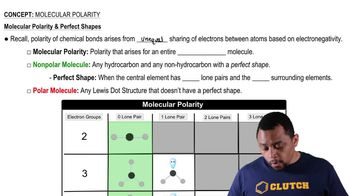
Molecular Polarity
Property resulting from uneven electron distribution across a molecule, leading to distinct positive and negative regions.
Electronegativity
Tendency of an atom to attract shared electrons in a chemical bond, influencing bond and molecular polarity.
Nonpolar Molecule
Species with even electron sharing, often due to identical surrounding atoms and absence of lone pairs on the central atom.
Polar Molecule
Species with uneven electron sharing, typically caused by lone pairs on the central atom or differing surrounding atoms.
Hydrocarbon
Compound composed solely of carbon and hydrogen atoms, generally exhibiting nonpolarity.
Perfect Shape
Molecular geometry where the central atom has zero lone pairs and all surrounding atoms are identical.
Central Element
Atom in a molecule to which other atoms are bonded, determining molecular shape and polarity.
Lone Pair
Non-bonding valence electron pair on an atom, often causing molecular polarity when present on the central atom.
Lewis Dot Structure
Diagram showing valence electrons around atoms, used to predict molecular shape and polarity.
Electron Group
Region of electron density around a central atom, including bonds and lone pairs, influencing molecular geometry.
Surrounding Element
Atom bonded to the central atom, whose identity and arrangement affect molecular polarity.