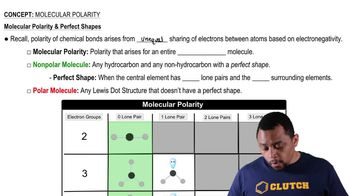
Polarity of chemical bonds is caused by the unequal sharing of electrons between atoms due to differences in electronegativity.
What is a nonpolar molecule?
A nonpolar molecule is either a hydrocarbon or a non-hydrocarbon with a perfect shape, meaning the central atom has 0 lone pairs and all surrounding atoms are the same.
What defines a perfect shape in a molecule?
A perfect shape occurs when the central element has 0 lone pairs and all surrounding elements are identical.
What happens if a molecule's central atom has lone pairs?
If the central atom has one or more lone pairs, the molecule is classified as polar.
How does having different surrounding elements affect molecular polarity?
If the surrounding elements are not all the same, the molecule is polar.
What is the relationship between Lewis dot structures and molecular polarity?
Lewis dot structures with 0 lone pairs on the central atom and identical surrounding elements are nonpolar; otherwise, they are polar.
What types of compounds are always nonpolar?
Hydrocarbons, which are compounds made only of carbon and hydrogen, are always nonpolar.
What is the effect of lone pairs on the central atom regarding molecular shape?
Lone pairs on the central atom disrupt the perfect shape, making the molecule polar.
How many electron groups can a central atom have and still be nonpolar?
A central atom can have 2 to 4 electron groups and still be nonpolar if it has 0 lone pairs and identical surrounding elements.
What is the key requirement for a molecule to be nonpolar besides having 0 lone pairs?
All surrounding elements must be the same for the molecule to be nonpolar.
What is the effect of breaking the perfect shape rule?
Breaking the perfect shape rule (having lone pairs or different surrounding elements) makes the molecule polar.
What is molecular polarity?
Molecular polarity refers to the overall polarity of a covalent molecule, not just individual bonds.
What is the significance of electron group arrangement in determining polarity?
The arrangement of electron groups affects whether the central atom has lone pairs, which influences polarity.
Can a molecule with 0 lone pairs on the central atom be polar?
Yes, if the surrounding elements are not all the same, the molecule can still be polar.
What is the simplest way to classify a molecule as polar or nonpolar?
Check if the central atom has 0 lone pairs and all surrounding elements are the same; if so, it's nonpolar, otherwise it's polar.