Back

Osmosis definitions

Control buttons has been changed to "navigation" mode.
1/14
  • Osmosis

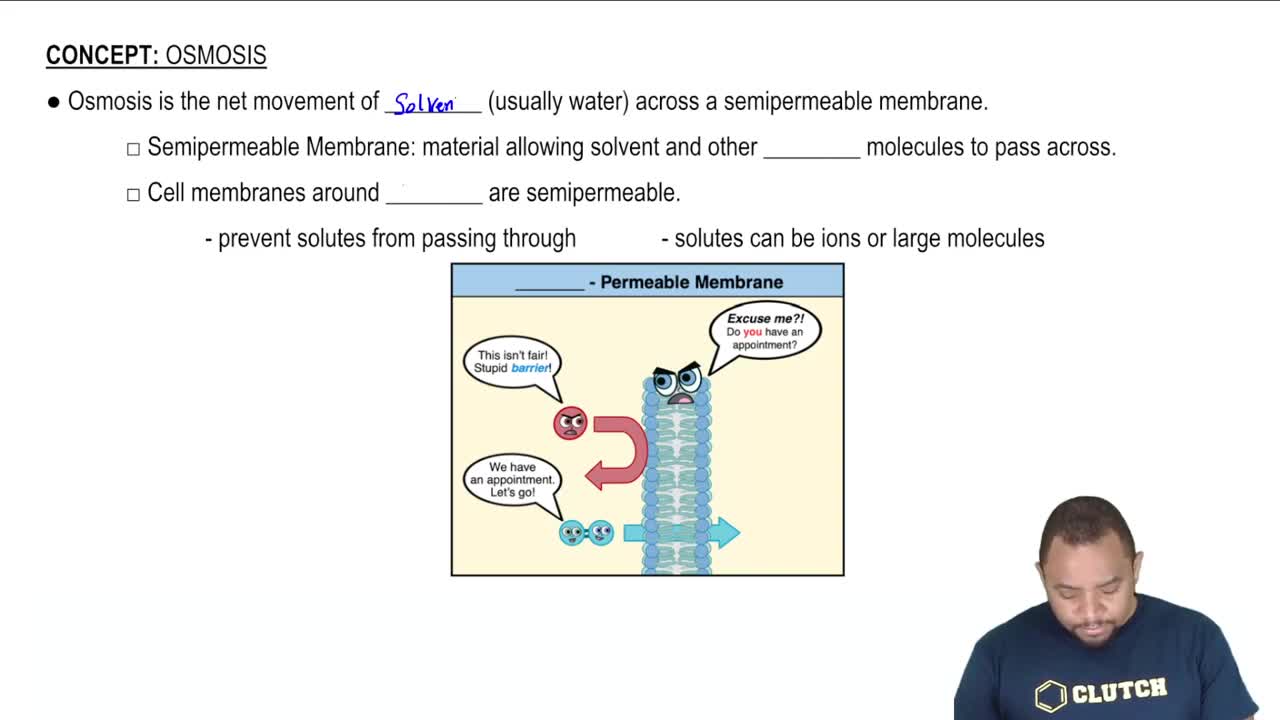
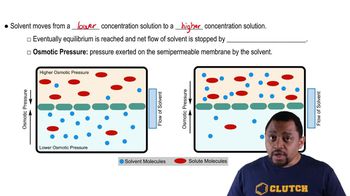
    Net movement of water across a semipermeable membrane from lower to higher solute concentration, continuing until equilibrium is reached.
  • Semipermeable Membrane

    Barrier that allows only certain small molecules, like water, to pass while blocking larger molecules and ions.
  • Solvent

    Substance, typically water, that moves through a membrane to balance solute concentrations on both sides.
  • Solute

    Dissolved particle, such as ions or large molecules, that cannot freely cross a semipermeable membrane.
  • Equilibrium

    State where concentrations on both sides of a membrane are equal, resulting in no net movement of water.
  • Osmotic Pressure

    Force exerted by water on a membrane, balancing solvent flow when concentrations are equal on both sides.
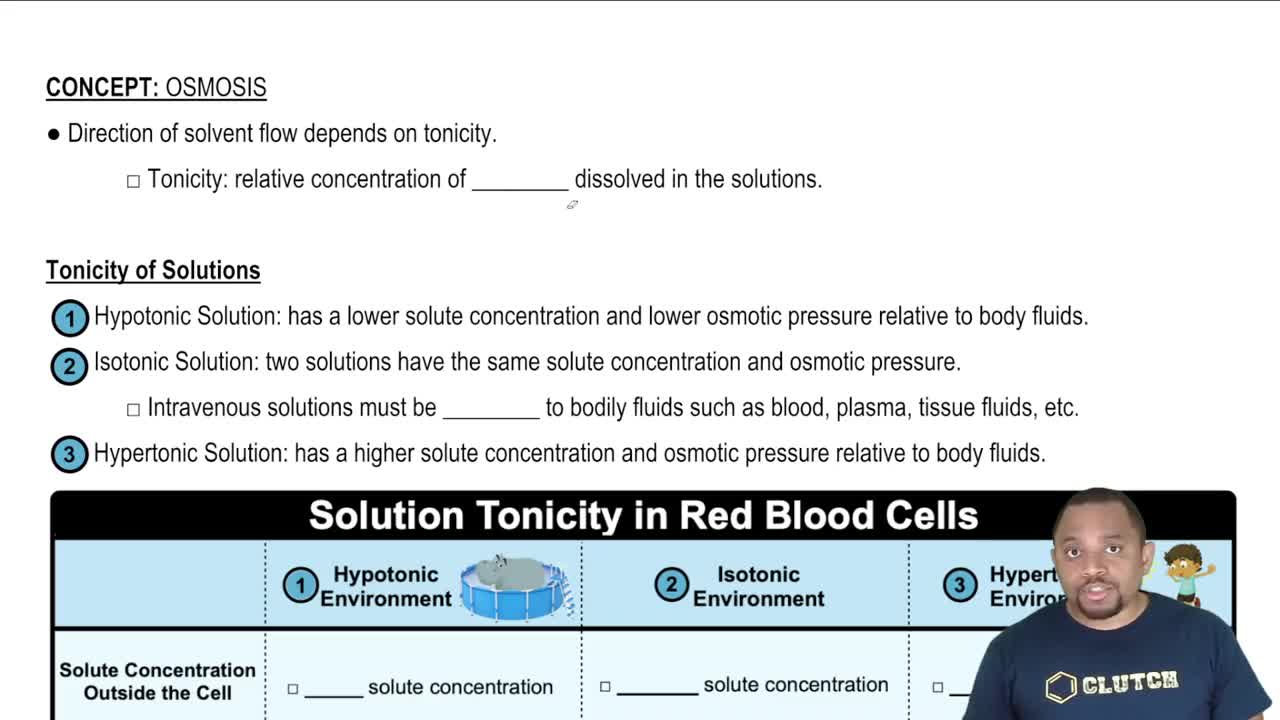
  • Tonicity

    Relative measure of solute concentration in one solution compared to another, influencing water movement.
  • Hypotonic Solution

    Solution with lower solute concentration and osmotic pressure than the cell, causing water to enter the cell.
  • Isotonic Solution

    Solution with equal solute concentration and osmotic pressure as the cell, resulting in no net water movement.
  • Hypertonic Solution

    Solution with higher solute concentration and osmotic pressure than the cell, causing water to exit the cell.
  • Hemolysis

    Process where a cell swells and may burst due to excessive water intake in a hypotonic environment.
  • Crenation

    Shriveling and dehydration of a cell caused by water loss in a hypertonic environment.
  • Red Blood Cell

    Cell type often used to illustrate effects of tonicity, swelling in hypotonic and shrinking in hypertonic solutions.
  • Intravenous Solution

    Fluid administered into the bloodstream, which must be isotonic to prevent cell damage.