Back

Osmosis quiz

Control buttons has been changed to "navigation" mode.
1/15
  • What is osmosis?

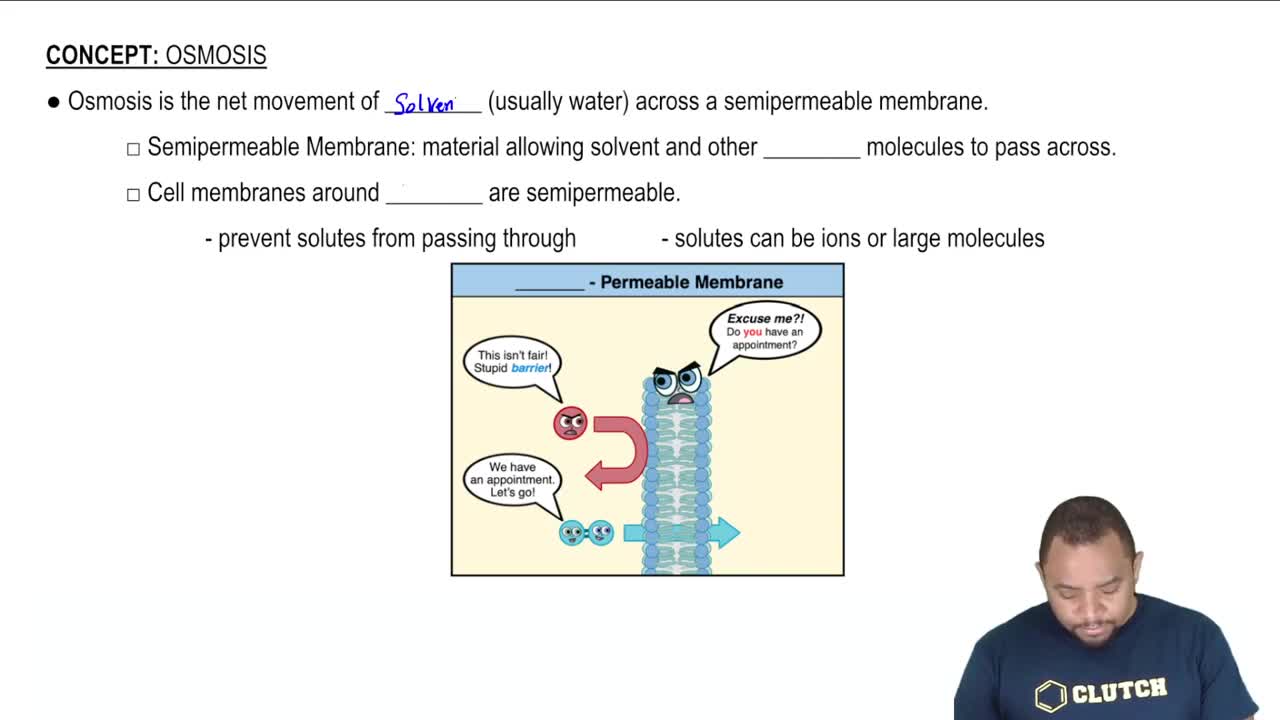
    Osmosis is the net movement of a solvent, usually water, across a semipermeable membrane from an area of lower solute concentration to an area of higher solute concentration.
  • What type of membrane is involved in osmosis?

    A semipermeable membrane, which allows only certain small molecules like water to pass while blocking larger molecules and ions, is involved in osmosis.
  • In osmosis, in which direction does water move relative to solute concentration?

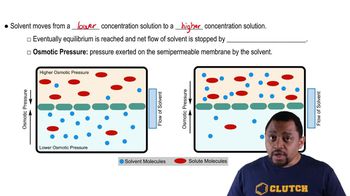
    Water moves from an area of lower solute concentration to an area of higher solute concentration.
  • What happens when equilibrium is reached during osmosis?

    When equilibrium is reached, the concentrations on both sides of the membrane are equal and the net flow of solvent stops.
  • What is osmotic pressure?

    Osmotic pressure is the force exerted by the solvent on the semipermeable membrane, which stops further net movement of the solvent once equilibrium is reached.
  • How does a semipermeable membrane function in osmosis?

    A semipermeable membrane allows small molecules like water to pass through but blocks larger molecules and ions.
  • What is tonicity?

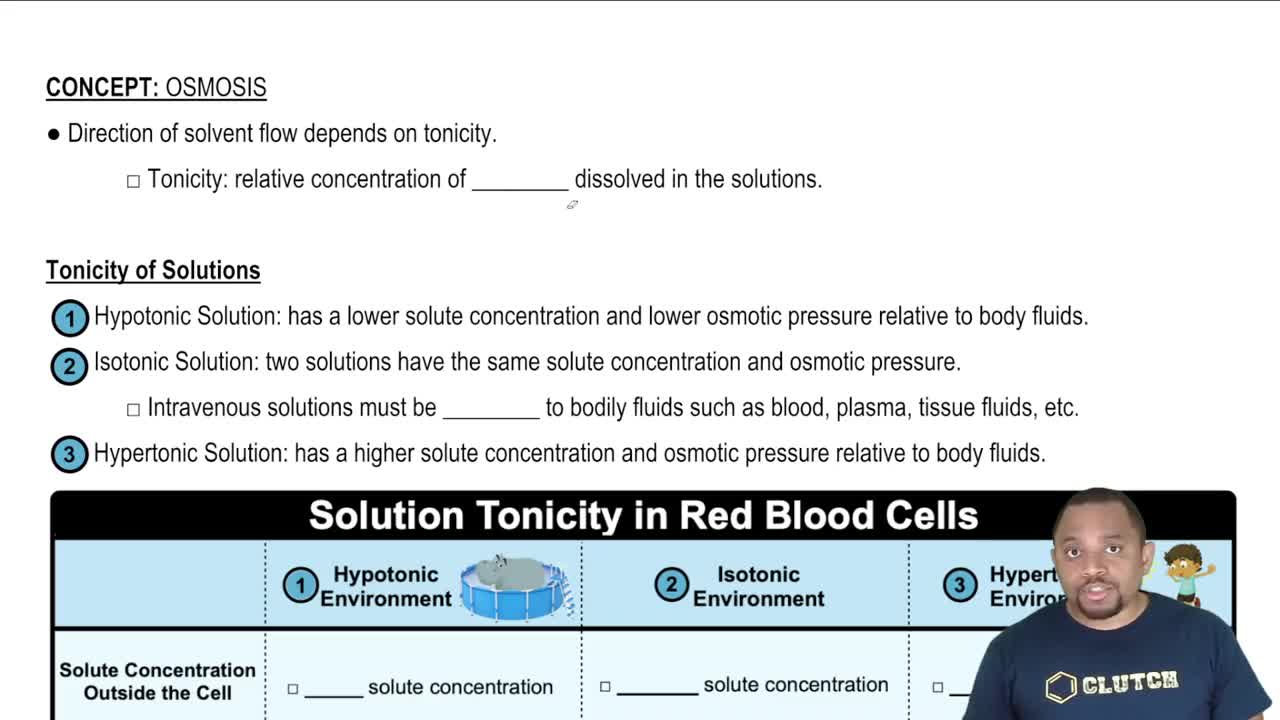
    Tonicity describes the relative concentration of solutes in a solution compared to another solution and affects the direction of solvent flow in osmosis.
  • What is a hypotonic solution?

    A hypotonic solution has a lower solute concentration and lower osmotic pressure compared to the inside of a cell.
  • What happens to a red blood cell in a hypotonic solution?

    Water enters the cell, causing it to swell and potentially burst in a process called hemolysis.
  • What is an isotonic solution?

    An isotonic solution has equal solute concentration and osmotic pressure compared to the inside of a cell, resulting in no net movement of water.
  • What happens to a red blood cell in an isotonic solution?

    The cell remains stable because water enters and exits at equal rates, so there is no net change in cell volume.
  • What is a hypertonic solution?

    A hypertonic solution has a higher solute concentration and higher osmotic pressure compared to the inside of a cell.
  • What happens to a red blood cell in a hypertonic solution?

    Water exits the cell, causing it to dehydrate and shrink in a process called crenation.
  • What memory aid can help you remember the effect of a hypotonic environment?

    A hypotonic environment can be remembered by thinking of a 'hippo' swelling with water, just like a cell swells in a hypotonic solution.
  • Why must intravenous solutions be isotonic to bodily fluids?

    Intravenous solutions must be isotonic to prevent cells from swelling or shrinking, maintaining cell stability and proper function.